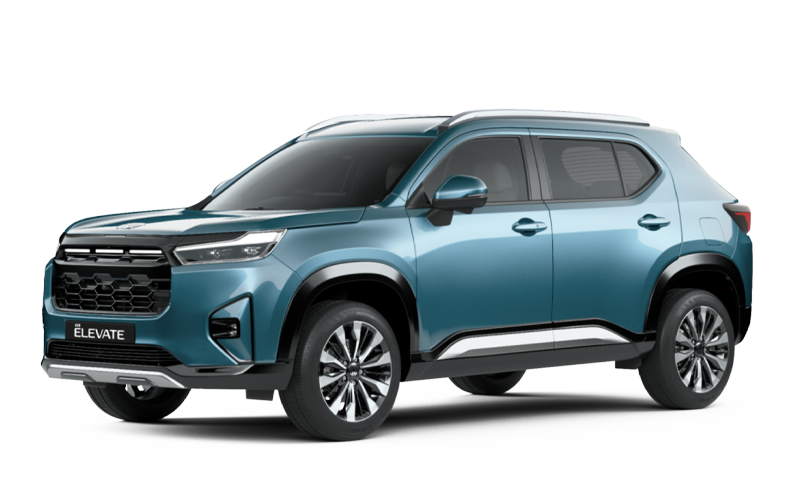
| Advantages | While the Honda Elevate offers respectable dimensions for its class, its boot space and ground clearance are the best in the segment. The Elevate offers 458 litres of boot space and 220mm of ground clearance, both of which are the best when compared to other C-segment SUVs. The base SV variant of the Elevate comes loaded with a good set of must-have and feel-good features. The features of the base SV variant include front and rear power windows, powered side mirrors, keyless entry with push-button start/stop, tilt and telescopic steering wheel, LED projector headlights, height-adjustable driver’s seat, LED tail lights, shark fin antenna, and a front armrest. The Honda Elevate offers a boxy design with an imposing stance. Design elements like a tall and flat bonnet, and a flat roofline help enahnce its road presence over its arch rivals. Like the City sedan, Honda offer advanced driving assistance systems (ADAS) with the Elevate, which helps improve the overall safety of the SUV. The Elevate gets ADAS features like auto emergency braking, lane keeping assist, and adaptive cruise control. The 1.5L normal petrol engine has proven its reliability in the Honda City and the sama engine is also offered in the Elevate without much changes. Hence, it is also likely to be very dependable and reliable compared to the small-capacity turbocharged engines of its rivals. Unlike its rivals who charge upward of Rs. 1.5 lakh for the automatic transmission option, Honda only charge Rs. 1.10 lakh over the equivalent manual transmission. Furthermore, Honda offer the automatic option in all Elevate variants, save for the base SV.
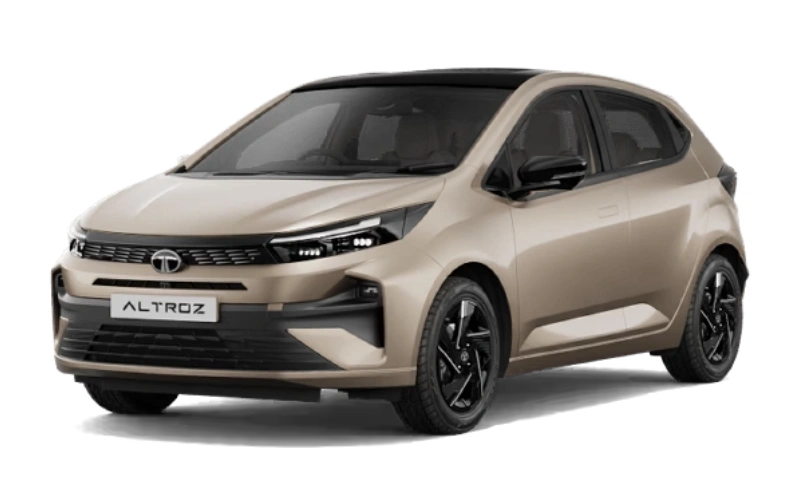
| Okay, as of June 8, 2025, Tata Motors haven’t yet confirmed that the Altroz has a 5-star rating from BNCAP or GNCAP. Moreover, the older Altroz wasn’t 5-star rated in accordance with the updated crash test scoring criteria, which mandate at least 6 airbags as a pre-condition for achieving 5-star rating. Sure, it had 6 airbags in higher variants and the Racer variants but this feature wasn’t available in most variants. And, it certainly wasn’t standard.
Now that it is, we should expect them to make this announcement any day now. And we shouldn’t expect anything less. For a brand that made a strong comeback on 3 things — sunroof, 5-star rating & design — it’s going to sound like business as usual.
If you just look a few years back, you’ll notice that Tata have had a horrible feature distribution. Their Nexon XMS had a sunroof and it sold in quite good numbers. But it didn’t have a front armrest or even a day/night inside mirror. Yet, it sold in huge numbers because their buyers were either upgrading from a much smaller car or it was going to be their first car. And they didn't know what features are important and what they won’t miss during the ownership.
But, things are changing and they are changing fast. Starting with the Punch feature revision, which came in late 2024, Tata are beginning to offer incredibly good feature distribution. The Tiago, Tiago EV and Tigor were also fantastic examples of drastic changes in the right direction. But the Altroz 2025 is just outstandingly good. It’s probably even a shade better than what we have seen in Hyundai cars.
Just like the feature distribution, the variant-to-variant incremental pricing is also amazing. Not only from the perspective of feature set and ownership experience, but also from the value-for-money angle, you can pretty much pick any of the Altroz variants (except base) and you will end up with a good balance of features as well as value (wrt price gap over the base model.) That’s something we didn't expect to say about a Tata car … ever.
Besides the value and feature set, Tata are also offering a solid diesel engine option. Their diesel Altroz is available in limited variants but all of them are pretty good. It’s great to see that Tata haven’t given up on diesel yet. Diesel engines not only offers better drivability and performance but also better longevity as it’s difficult to adulterate it without making it too obvious. Petrol now contains 20% ethanol, which affects your fuel efficiency, vehicle’s long-term reliability and doesn’t give any cost advantage either. For those interested in high usage, the diesel also doesn’t compromise on the boot space.
If you are totally against the diesel engine option or your state government has forced/manipulated you into believing so, then you also have the option of a CNG powertrain. And unlike most other CNG carmakers, the Altroz CNG is also quite practical w.r.t. boot space.
The 1.2L normal petrol engine of the Altroz has 2 automatic transmission options — a cost effective 5-speed AMT and a more refined 6-speed dual-clutch. Depending on your budget and your preference, you can pick either. The other cars in the same segment have made the choice for you. The Glanza/Baleno only have the AMT automatic while the i20 only has the smooth CVT automatic. The diesel engine of the Altroz offers 200Nm of torque from 1250rpm, which is barely higher than idle RPM. This makes it a great choice, whether you want to drive the car in the city or cruise on the highways. Other than the 3XO, no turbo petrol car under Rs. 10.0 lakh can offer this kind of effortless performance.
But here’s the kicker – even if a turbo petrol did offer better performance, it would fail to offer better efficiency. The Altroz diesel claims to offer a fuel efficiency of 23.60kmpl. Turbo petrols’ poor efficiency figures are partly because of the nature of the fuel and partly because of the ethanol adulteration. If you are convinced with the performance and efficiency advantages of the Altroz diesel, then this should push you over the fence. Once we factored in the performance advantages and the fuel cost difference over the course of 50,000km, the Altroz diesel manages to justify 96% of its Rs. 1.30 lakh incremental cost over the comparable petrol variant. If you expect to drive considerably more than 50,000km during the ownership, then the diesel engine is a solid option. In fact, the more you drive it, the better value it delivers.
Please note that we have considered the official mileage figures and fuel price in Delhi to calculate the fuel cost. If you are not a fan of diesel engines or the government is making you stay away from diesel cars, then CNG is the next most viable option. While it doesn’t justify the incremental cost over petrol after factoring in the reduction in performance and boot space.
However, you can’t do much better than the Altroz. It’s one of the few CNG cars in India with a usable boot space. In the case of Altroz, it’s 211 litres. This is certainly less than the petrol or diesel Altroz, but the shape of the cargo area makes a big difference. Should you need to, you can carry a refrigerator or a washing machine in the Altroz CNG. You can’t do that in most other CNG cars with a price tag of less than Rs. 10.0 lakh (ex-sh).
|
| Disadvantages | The Honda Elevate misses features such as a panoramic sunroof, front ventilated seats, tyre pressure monitoring system (TPMS), powered driver’s seat, and 360-degree parking camera. While the lower variants of the Elevate offer a good set of feel-good and must-have features, features such as side thorax and curtain airbags, rear armrest, and ADAS are only offered in the higher variants. While the normal petrol engine of the Elevate is the most-powerful among its normal petrol and small-capacity turbo rivals, it lacks the torque and superior driveability of its rivals.
| As good as the Altroz diesel is, unfortunately, it is not available in our top recommended Creative variant. At the launch prices, the Creative diesel could have easily been available with an ex-sh price of Rs. 9.99 lakh while maintaining a consistent Rs. 1.30 lakh premium over Creative petrol-manual. The Pure diesel is good, but the Creative variant has a better feature balance offering a few more must-have and some good-to-have features.
The Altroz is well loaded across all variants but a few features are still missing even in the top variant. Split-folding rear seat backs and telescopic steering come to mind immediately. These are available in the Baleno, which is the benchmark for this segment and the prime rival for the Altroz.
We wish it also had UV-cut glass panes, front parking sensors and 360-degree cameras. If it had 6 front and 6 rear parking sensors, that would have eliminated the need for more expensive 360-degree cameras but this is a tall order. When they only offer 2 front and 2 rear parking sensors even with a car as expensive and as wide as the Safari, we should be grateful that they didn’t remove the sensors in variants with the rear camera. They have only recently started offering 12 sensors with the Harrier EV.
Dual-clutch automatics are yet to demonstrate their long-term reliability. Most car manufacturers have discontinued their DCT offerings from their mass market lineup in India. The strange thing is that none of them managed to figure out if it was the driving conditions or the climate, which was causing pre-mature failure. And that’s despite decades of experience making dual-clutch automatic transmissions. MG, Skoda, Volkswagen and Ford have offered DCTs in their sub-Rs. 10.0 lakh cars and they all withdrew them from this price band. Note that Ford India pulled the plug on their DCT option in India before they pulled the plug on themselves.
Hyundai and Kia have only recently started offering DCTs in their mass-market cars and their first batches are just beginning to come off warranty. So, it’s too early to say that DCTs will offer good long-term reliability.
Moreover, this is Tata’s first DCT automatic. So, you shouldn’t expect great reliability. Not just because it’s from Tata, but also because it’s a DCT and a first-gen product. If you are interested in long-term reliability and keeping your maintenance costs low, the AMT is a far better option.
CNG cars offer lower running costs but they also offer less power, less torque and less cargo volume. Do note that non-turbo petrol engines already don’t offer great drivability like a hybrid or a turbocharged engine. Once we factored in the performance, the reduced boot space and lower fuel costs, the Altroz CNG only managed to justify about 63 - 74% of the incremental cost. CNG cars generally are poor in this area and even the usable boot space wasn’t enough to cover up the price gap of Rs. 94,000 with the Creative S CNG variant.
The poor service centre experience is one thing we can’t objectively judge since it varies from person to person. But the 6-month service centre visit is objectively a terrible idea.
First of all, even if you don’t have to get the oil changed during every alternate service, there’s still a service cost, which will add to your overall maintenance cost. According to Tata’s own estimates, the 5-year/50,000km maintenance will end up costing you around Rs. 50,000. That’s an average of Rs. 10,000 per year.
Secondly, every time you visit the service centre, the service “advisor” will try and upsell you something. Some of those “recommendations” will be value-added services like throttle body cleaning, underbody rust coating, teflon coating, etc. Others will be “precautionary” maintenance. If you deny these, they will try their best to use this as an excuse should you need to claim warranty on related parts.
And if you choose to avoid the alternate 6-month visit, then Tata Motors will use that as an excuse to deny you any warranty. There’s no good outcome here for the car owner. CNG AMT is a powertrain exclusive to Tata Motors currently available with the Tiago and Tigor. We wish Tata also offered it with the Altroz so that city-dwellers can pick this option to conveniently crawl in city traffic. With the May 2025 update, the Altroz Racer variants are discontinued. This makes Hyundai i20 the only car in the B2 hatchback segment with a turbo petrol engine. However, Tata are likely to bring the turbo petrol back to the Altroz in about a year or so. Addressed with the May 2025 Altroz facelift update. Not applicable after the May 2025 Altroz facelift update. Addressed with the May 2025 Altroz facelift update.
|


 Upcoming Cars