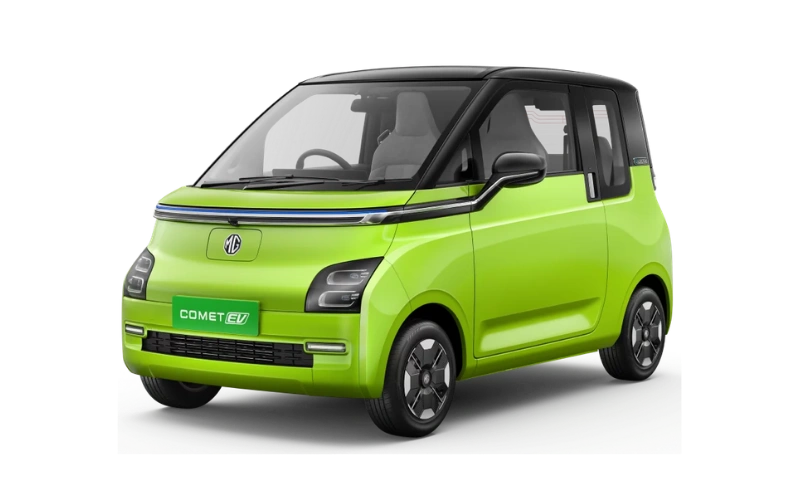
| Advantages | With a length of just a shade under 3 metres, the Comet EV is even smaller than the Tata Nano. It currently is one of the smallest passenger vehicles available in the country. Combine its compact dimensions with a 4.2m small turning radius and you have a very city-friendly compact electric vehicle.
Despite having such a small footprint, the Comet EV can actually accommodate 4 adults with ease. It gets a 2-door format and both the front doors offer a large opening and the space for the rear passengers is generous too. Since the Comet EV is also fairly tall, headroom for even 6 footers is not a problem inside the Comet EV.
The Comet EV looks unlike anything on the road. Its compact design complimented with quirky styling give it a unique appeal on the road. Furthermore, its connected LED light bars at the front and rear along with LED headlights and tail lights also give it a modern stance. If you fancy a colourful livery splashed around your EV, MG Motor India also offer a slew of customisation packs.
Unlike other budget-centric EVs in the market, the Comet EV is underpinned by an EV-specific platform. Other budget EVs in the market like the Tata Tiago EV and Citroen eC3, on the other hand, are based on the modified ICE platform. Thanks to the EV-specific platform, the Comet EV manages to offer surprisingly good space to its passengers despite its tiny dimensions.
MG Motor updated the Comet EV in March 2024 with feature additions like power-folding mirrors, crawl function, faster AC charging capability, e-parking brake with auto hold and a storage space between front seats to make it easier to live with. The high seating position, low-set dashboard and the large quarter glass of the Comet EV drastically improves all-around visibility and makes it easy to drive both in the city and on the highway. Although the MG Comet EV only offers a ground clearance of 165mm, the short wheelbase of 2010mm makes it very usable over poor roads and tall speed breakers. Despite a low power figure, the city drivability of the Comet is, in fact, far superior to the non-turbo petrol engines of up to 1.2L displacement. The MG Comet EV’s tall-boy design coupled with XL sized doors makes front seat ingress and egress as easy as walking in or out.
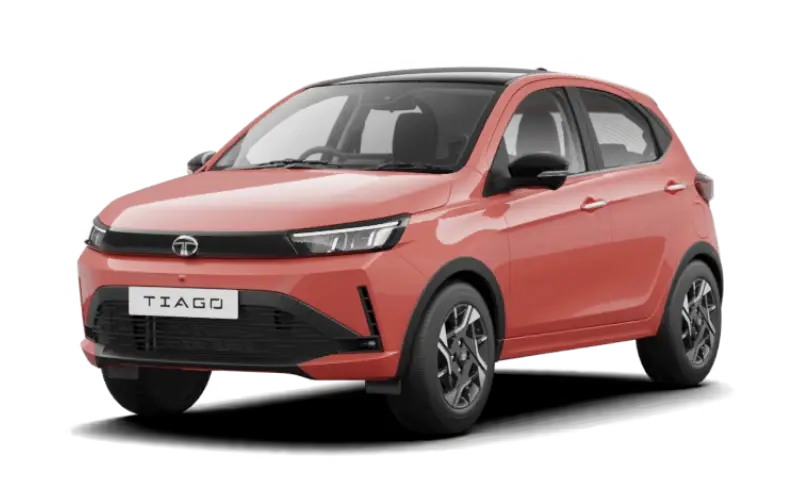
| With the 2025 model year update, the Tiago has become quite interesting with its feature distribution. It retains the simple variant lineup which makes it easy to select a variant. However, earlier, the feature distribution wasn’t the best. You had to stretch for the higher variant with a bunch of good-to-have features just to get a couple of must-have features. This time, it’s much nicer.
For instance, alloy wheels, which are easy to install post purchase and don’t add much value to the functionality are available in top variant. Meanwhile, some must-have features such as rear defogger, ESC, power mirrors, steering-mounted controls are available in the mid-spec XT variant. Higher, XZ also adds some meaningful and useful features such as auto AC, auto headlamps, auto wipers, LED headlamps, larger touchscreen and DRLs before moving up to XZ Plus. Even the lower XM variant gets height-adjustable driver seat, all power windows, day/night inside mirror and a music system.
So, no matter which variant you pick you will get a good feature distribution for a car of its price and segment.
With the 2025 model year updates, the Tiago now brings LED headlamps, wireless Android Auto and Apple Carplay and a larger touchscreen with smoother and responsive interface. These changes, along with some cosmetic updates such as the new steering wheel with backlit Tata logo, its leather wrapping and the larger touchscreen next it make the car feel much more premium from the driver’s seat.
The top model comes quite loaded with features like auto AC, auto LED headlamps, auto wipers, TPMS, cruise control, large touchscreen, with wireless Android and Apple connectivity, keyless entry and go and a cooled glovebox.
While the Tiago is no SUV, it has a better ground clearance than a typical hatchback. 170mm on the standard variants is quite respectable. Moreover, if you do need the high ground clearance for the terrains you have to tackle, there’s the NRG variant, which is available with petrol-manual, petrol-auto, CNG-manual as well as CNG-auto powertrain options. What’s great about this NRG variant is that you don't have to pay a lot for the SUV styling like you do when buying bigger cars like the Exter, Punch, Kiger etc. The Tiago NRG is quite reasonably priced for what it offers.
Unlike some of the other non-turbo petrol cars, the Tiago’s petrol engine delivers its torque a little sooner at 3300 - 3500rpm. The rivals offer peak torque at 4000rpm or higher. This feature gives the Tiago a marginally-better drivability.
The Tiago, of course, offers the usual petrol-manual and petrol-AMT automatic options. Additionally, it also brings the CNG-manual powertrain. But it doesn’t stop there. The Tiago is one of the rare cars in India to offer a CNG-automatic powertrain option. Tata Motors don’t just have the CNG-AMT. The CNG variants of the Tiago also have a usable boot space. With 2 cylinders to hold the gas under the boot floor, there’s quite a usable cargo volume of more than 100 litres even in the CNG variants. This is another rare feature of Tiago CNG variants. Although, Hyundai have also started offering this with the Nios and Exter. No longer applicable as BNCAP/GNCAP crash test procedure has changed significantly since the Tiago was tested back in January 2020.
|
| Disadvantages | Having 12-inch wheels on a budget car isn’t a new thing in the Indian market, but the same-sized wheels look diminutive on the Comet EV owing to its tall stance. The MG Comet EV stands 1640mm tall, which is considerably taller than the Tiago EV.
While the Comet EV offers surprisingly good space for its passengers, it couldn’t accommodate their weekend worth of luggage. The Comet EV offers a tiny boot space which is occupied by the puncture repairing kit and portable charger. As a result, the boot of the Comet EV can’t store any more luggage than a backpack.
Poor ergonomics like steering position, garden-chair seats and limited seat contouring make it a terrible option for covering long distances
The Comet EV offers a very quirky styling that may not go down well with everybody’s taste. Someone who prefers to have a conventional car bodystyle with 4 doors and better boot space can shell out a little extra and jump to the Tata Tiago EV.
If you intend to frequently use the rear seats, then note that the access to the rear seats is quite cumbersome. Despite the large doors that make ingress-egress easy for front row passengers, the front seats do not slide far forward to make rear seat ingress-egress easy for adults. Although MG claims the Comet EV is equipped with TPMS, we experienced a flat tyre without any prior warning of low pressure. We drove the Comet EV for a fair bit with the flat tyre and the system failed to recognise a loss of pressure. Upon further inspection, we found that there are no TPMS sensors on the wheels. The motor and some wiring underneath is exposed to the elements of nature while the rear differential is the lowest part of the car; it is a concern to watch out for when traversing over bad roads The Comet EV doesn’t support DC fast charging, thus limiting its usage within city confines only. Other EVs in its price bracket like the Tata Tiago EV, Tata Tigor EV and Citroen eC3 offer DC fast charging. Mostly addressed with 2024 model update (7.4kW AC fast charging capability)
| Compared to the Nios and Ignis, the 3-cylinder engine of the Tiago doesn’t feel as refined. Pushing it up the rev band, even just around 3000rpm, which is only 50% of the redline, the engine feels like it’s protesting.
Maruti Suzuki beating Tata Tigor with their 5-star Dzire is one thing. But the Alto K10 offering 6 airbags as standard in variants which don’t even get power steering and air conditioning while the Tiago continues with 2; now that is gonna hurt the Tiago and Tata fanbois.
Even in the top model of the Tiago, you may still miss features such as split-folding rear seat backs, rear AC vents, front centre armrest, front side thorax airbags and curtain airbags.
You won’t just miss out on some features with the Tiago top model. You also won’t get the option of buying it with an automatic transmission. It’s the same story whether you choose the petrol or the CNG engine option.
The base model of the Tiago carries an aggressive price tag, it does miss out on several features we have come to expect from any modern day car. For instance, it doesn’t get day/night inside mirror, height-adjustable driver seat, power mirrors, power windows, wheel covers and more. It also gets 13-inch wheels with skinny 155-section tyres. Even the cheaper Renault Kwid gets 165-section tyres on 14-inch rims.
The Tiago first went on sale early in 2016 with Zica badging on its boot and the legendary Messi promoting the car. It is now 9 years old, and for 2025, it’s again getting mild updates. 9 years is an awfully long time in the auto industry for a car to continue without a major overhaul. The 2025 model year update should prolong its life for another couple of years making it at least 11 years old before people really start hating the old design and stop buying it altogether.
That is not the saddest part though. What’s worse is that there’s no generation update in Tata’s pipeline for the Tiago and its sedan twin. Unless the customers’ buying power severely deteriorates in the coming years with a horrific economic slowdown, we don’t see Tata keeping the Tiago in their portfolio for too long. That means, even if you buy the car today, you may run into problems such as lower resale value because of model discontinuation and difficulty securing slow-moving parts for maintenance.
While every other carmaker out there has managed to figure out how to make vehicles that are reliable enough to only need yearly service, Tata appear to be stuck in the past. Or perhaps they are not! Perhaps, this is a strategy to extract more money out of their customers’ pockets.
While they will only replace consumables during every alternate visit, they will make you pay for labour even on visits where they only claim to have done some checks on the car. This adds to the hassle during the ownership and the overall cost of maintenance.
If you’re not assertive enough, then rest assured that at every service centre visit, the advisor will “advise” you to get some or the other preventive maintenance done even if they are absolutely unnecessary. Denying these optional services is going to be tricky because they are going to spend a whole lot of time with your vehicle. You don’t wanna make enemies with the service advisor because it’s fairly easy to sabotage your vehicle in a way that it will work fine for a few months and break down later during the ownership. Then, they might claim that they told you so. After all, they are the experts.
Thus, this might add to your maintenance costs. And if you don’t maintain a cordial relationship with your service centre reps, then you also run the risk of getting some warranty claims denied in future. The rest of the auto industry recommends yearly service centre visits. In such cases, you only have to see the service centre once every 12 months. So, it’s much less riskier to fight your way through their "recommendations". They probably won’t even remember you 12 months later.
|


 Upcoming Cars