

Published : 31 January 2026
Read Time : 5 min
Author: Mahesh Yadav
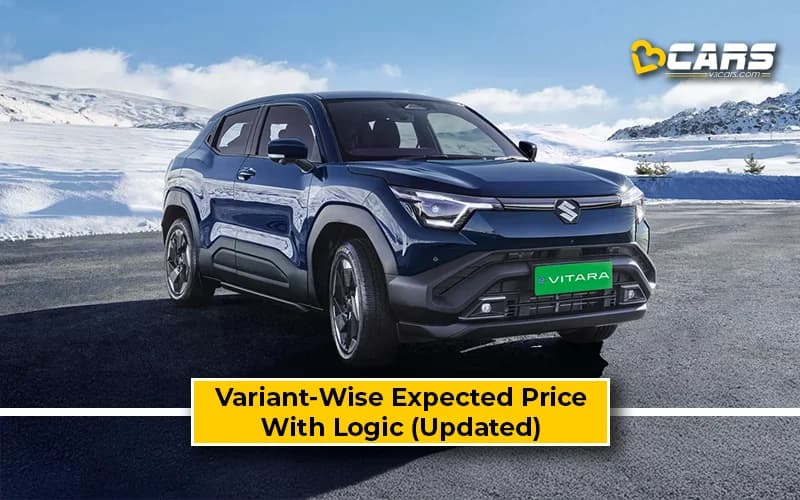
In this article, we’ll estimate the ex-showroom price range of the upcoming eVitara — Maruti’s first electric SUV to compete with the C-segment electric SUVs like the Hyundai Creta Electric, Tata Curvv EV, MG Windsor, Mahindra BE6 and Vinfast VF6. We’ll explain the logic behind the calculations along with the reasons to support our conclusions in the EVitara expected price table. As and when we get more information affecting our estimations about the¸ Vitara electric price, we’ll update this article to accommodate new findings.
Updated (Jan 31, 2026): We have revised the expected prices of the Maruti Evitara based on our assumptions about the brand’s long-term aspirations for the electric powertrain.
Also Read: 2026 Toyota Ebella Variants Explained - Which One To Book?
Note: Check your car’s fuel cost with Fuel Cost Calculator in India
Maruti Vitara Electric Variants
The eVitara from Maruti will come with 2 battery options:
- 49kWh (440km ARAI range)
- 61kWh (543km ARAI range)
Almost a year ago, we received information about the Evitara getting 3 variants. While we still don’t have a clear confirmation on this, the Toyota Ebella brochure confirms that our information was indeed correct. The variant naming is expected to be as follows:
- Delta
- Zeta
- Alpha
Also, based on the now year-old information, we can confirm that the base variant will only get the smaller 49kWh battery pack option. The mid-spec Zeta and eVitara top model will get only the larger 61kWh battery pack option.
Maruti E Vitara 2026 — Starting Price Expectation
To get an idea about the starting price of the Maruti eVitara, we will first have to look at the price bands of its closest rivals.
Hyundai Creta EV (Ex-Sh Price Range Rs. 18.02 - 23.67 lakh)
The Creta Electric is available in the Rs. 18.02 - 24.70 lakh price range excluding any special editions and the — very expensive — 11kW AC home charger. This is the prime challenger to the EVitara as Hyundai’s sales and service centre reach is comparable to Maruti’s, if not better. Moreover, the Creta is a stronger brand than the Vitara among the C-segment SUVs.
The Creta also offers a smaller battery pack with only 42kWh capacity while the Vitara will bring a 49kWh battery pack with the base model. The eVitara will also offer a few extra standard features such as sliding and 2-step reclining rear seats and a driver knee airbag.
MG Windsor EV (Ex-Sh Price Range Rs. 14.0 - 18.50 lakh)
The Windsor EV’s launch price was nice at Rs. 13.50 lakh. While the 1-year of unlimited free public charging turned out to be more of a publicity stunt than anything else, it did move a lot of stock initially and got the ball rolling for MG.
It is about as long as the Creta Electric but wider than all C-segment SUVs. The only thing you might find weird is its bubbly looks. Regardless, it comes across as a tough challenger for the e Vitara.
Mahindra BE6 (Ex-Sh Price Range Rs. 18.90 - 26.90 lakh)
Another big problem for the eVitara is the Mahindra BE6. It not only offers a larger battery as standard, it also gets flashy styling and a host of tech features deserving of a conversation. Thankfully, its top model price will give the eVitara some breathing room.
On a positive side, the industry expectation that Mahindra may not be able to deliver reliability with such a revolutionary and tech-laden product is also valid. So, the Vitara EV can relax knowing that they have a challenger in the BE 6 but it doesn’t have the same overlapping set of buyers who want a smooth and predictable ownership experience.
Mahindra XEV 9S (Ex-Sh Price Range Rs. 19.95 - 29.45 lakh)
However, more than anything else, I believe the XEV 9S is the one that threw a heavy monkey wrench into the pricing strategy for Maruti Suzuki. Regardless of the potential long-term revenue loss for the carmaker (from lower maintenance) and the government (from no petrol/diesel sale), Mahindra have global aspirations. And this clearly shows in thei pricing of the XEV 9S.
First of all, it gets the larger battery pack as an option in the base model with an ex-showroom price of only Rs. 21.95 lakh. Secondly, the car is a 7-seater. Considering the low GST and negligible registration costs of electric cars in most states, the 9S 79 variants’ starting price makes even the mid variants of the Clavis petrol and diesel appear overpriced. The total cost of ownership for the 9S is incredibly low with home charging as there are no petrol or diesel fillings required.
This is the car that is making Maruti’s job really tough even though they are not even in the same league. They have vastly different dimensions, performance figures, battery options and long-term reliability prospects. And, Mahindra are going all in on EVs to establish themselves as a dominant player in this automotive sub-domain; not just in India, but around the world.
2026 Maruti e Vitara EV — Expected Price Summary
Now, we have 2 sets of price bands to consider:
- Rs. 17.0 - 20.0 lakh: This is applicable only if the carmaker are interested in selling the Evitara and achieving scale in the country of production. However, they are also aware of the loss of future revenue from lower maintenance costs. Also, the usual tight knit relationship of Maruti Suzuki management and the government officials should suggest that they may be facing the pressure. Maruti Suzuki might also be under the pressure of making sure the electric revolution doesn’t go so big that the government’s revenue from selling petrol, diesel and CNG goes down drastically.
However, if they really want to capture the EV space and make room for themselves, then this is the tentative price band we should expect for the Evitara.
- Rs. 18.0 - 22.0 lakh: The higher price band makes more sense since selling an all-new powertrain, that too one where they have minimal to no experience w.r.t. their long-term reliability could backfire. They may run into difficulties maintaining the cars for their customers and the downtime could erode trust in the Maruti Suzuki brand white ruining their image as a reliable option for EV buyers.
So, they may want to choose carefully and price it at a level that they can handle the volume of cars at the service centres while keeping their warranty expenses under control.
We believe the higher price will limit early adoption and give Maruti longer time to refine any issues further without risking an implosion. Then, they can scale up or down depending on how the government wants them to proceed and how their own profitability directs them.
Also Read: 2026 Mahindra XEV 9S Variants Explained — Which One To Buy?
Note: Check your Car EMI with our - Car Loan EMI Calculator