

Published : 11 July 2023
Read Time : 5 min
Author: Mahesh Yadav
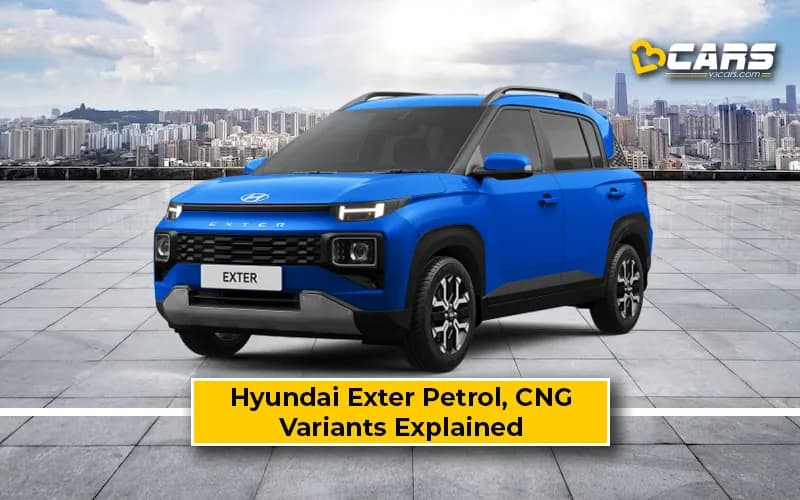
In this variant explained article, you'll find out which variant of the Hyundai Exter petrol or CNG you should buy based on the ex-showroom prices, variant-wise features and value for money. Here we compare and objectively analyse the Exter's petrol and CNG variants and the features to figure out which variant is worth buying for a good value for money and ownership experience. Then we will compare the engine specs, dimensions and mileage of the Hyundai Exter with its competitors and other CNG- and petrol-powered affordable SUVs and crossovers like the Tata Punch, Maruti Nexa Ignis, Hyundai Exter, Citroen C3, Renault Kiger and Nissan Magnite.
Also Read: Tata Punch CNG Expected Price - Variant-Wise Calculation
Maruti Suzuki Fronx Petrol Variants Explained - Which One To Buy?
What Are The Pros And Cons Of Hyundai Exter Petrol, CNG?
The pros or advantages of Hyundai Exter petrol and CNG are:
- Fantastic starting price and good pricing for rest of the variants too
- 6 airbags as standard and optional ESC and HSA right from the base variant
- Option of petrol-manual, petrol-automatic and CNG-manual powertrains from day 1
- Good number of features like sunroof, auto AC, rear AC vents, cruise control, keyless entry, cooled glovebox, projector headlamps, LED front and rear lighting, TPMS and wireless phone charger
- Segment-first features like dual-camera dashcam, paddle shifters with AMT and multilingual interface with Indian language support
- Good mileage figures with petrol as well as CNG powertrains
- Respectable ground clearance of 185mm
- 391-litre boot space is larger than that of the even the Nissan Magnite, which is a much bigger car
The Hyundai Exter petrol/CNG has the following shortcomings or problems:
- Missing features like wireless Android Auto and Apple Carplay, split-folding rear seatbacks and front and rear armrests
- With the CNG, it won’t offer better boot space than the upcoming Punch CNG as it has better cylinder packaging (Know more: Auto Expo 2023: Tata Solved Boot Space Problem With CNG Cars)
- A price overlap with the Venue 1.2L may make some buyers consider buying the larger Venue SUV
What Is The Price Of Hyundai Exter Petrol, CNG Variants?
The Hyundai Exter is available with 3 powertrain options:
- Petrol-manual
- Petrol-AMT automatic
- CNG-manual
The petrol-manual range is available in 5 main variants — EX, S, SX, SX (O) and SX (O) Connect. The Exter petrol-manual variants cost between Rs. 6.0 lakh and Rs. 9.32 lakh. The petrol-automatic powertrain is available in the higher 4 of the same variants with ex-showroom prices ranging from Rs. 7.97 lakh to Rs. 10.0 lakh. The AMT automatic variants cost about Rs. 70,000 more than the comparable petrol-manual trims.
The Exter’s bi-fuel CNG-manual powertrain is available in S and SX variants, which cost Rs. 8.24 lakh and Rs. 8.97 lakh, respectively. These prices are exactly Rs. 97,000 more than the petrol-manual models.
Hyundai Exter Petrol EX - Base Model Standard Features
The base model of the Hyundai Exter is only available with a petrol-manual powertrain and costs Rs. 6.0 lakh. The Exter EX has the following notable features:
- 6 airbags as standard
- 5x 3-point seatbelts
- Hill start assist (with EX (O) only)
- Electronic stability control (with EX (O) only)
- Remote central locking
- Front power windows
- Height-adjustable driver seat
- 14-inch steel wheels without covers
- Floor mats
- Body-coloured bumpers
- Black outside mirrors and door handles
- Gloss black rear garnish
- Fabric upholstery
- LED tail lamps
The base variant doesn’t get the following important features:
- Music system
- Rear power windows
- Day/night inside mirror
- Rear washer wiper
- Rear defogger
- Rear parcel tray
- TPMS
Please note that in the interest of better safety for all our audience, we’re only considering the EX (O) variant, which gets ESC and HSA. While it costs a tad more than it should for the 2 extra safety features, we’ll advise against buying the base EX variant without these features.
With that out of the way, we have to say that the sub-Rs. 6.0 lakh starting price of the Exter does make it quite an attractive option, even for hatchback buyers. If you’re on a tight budget, then we’ll suggest you make the most of the attractive introductory prices of the Exter and buy the EX (O) variant. Since it doesn’t get a few must-have features, you could choose the aftermarket options to meet those needs.
Hyundai Exter Petrol, CNG EX vs S Variant - Price, Feature Comparison
The S variant gets all 3 powertrains. The Hyundai Exter S variant costs Rs. 7.27 lakh with the petrol-manual, Rs. 8.24 lakh with CNG-manual and Rs. 7.97 lakh with petrol-automatic powertrain.
This variant is Rs. 1.27 lakh pricier than the base EX variant. Meanwhile, the CNG and petrol-automatic cost Rs. 97,000 and Rs. 70,000 more than the Exter S petrol-manual.
Since, we’re considering the ESC- and HSA-equipped variants only, the jump from EX (O) to S (O) petrol-manual costs Rs. 1.17 lakh. This is because the S (O) is only Rs. 15,000 pricier than the S variant while the EX (O) is Rs. 25,000 pricier than the EX variant.
Over the base EX variant, the Exter S variant adds the following notable features:
- ESC, HSA (available with S (O) variant; standard with CNG and AMT automatic)
- 8-inch touchscreen
- 4x speakers
- Wired Android Auto and Apple Carplay
- Steering-mounted controls
- Rear AC vents
- Rear power windows
- Rear parcel tray
- Day/night inside mirror
- TPMS
- Power mirrors
- Power folding outside mirrors (AMT only)
- LED DRLs
- Body-coloured mirrors and door handles
- Wheel covers
- Gloss black grille
While the S variant covers the basics quite well, you may still miss the following features in this variant:
- Rear seat back split folding
- Rear washer wiper
- Rear defogger
- Rear camera
- Tilt steering
- Keyless entry with push-button start/stop
To be honest, the S variant seems to get a good number of features for a car of this segment and ex-showroom price. The problem is because of the attractively-low price of the base EX variant. It created a large price gap between the EX and S variants, which makes the S a little expensive for the features it adds over the EX. Moreover, the higher SX variant gets a good number of features along with a far better value score. So, it’s better to just skip the S or S (O) variants and buy the SX trim instead.
Hyundai Exter Petrol, CNG S vs SX Variant - Price, Feature Comparison
The SX variant also gets all 3 powertrain options. It costs Rs. 71,000 - 73,000 more than the lower S variant with similar powertrain options. The Exter SX petrol-manual costs Rs. 8.0 lakh, the SX CNG-manual costs Rs. 8.97 lakh while the SX petrol-automatic costs Rs. 8.68 lakh (ex-showroom).
Since we’re looking at the S (O), the effective price jump for petrol-manual buyers from S (O) to SX variant is Rs. 58,000.
The SX variant of the Exter adds the following notable features over the S or S (O) variant:
- Shark-fin antenna
- Fabric+leather upholstery
- Tilt steering
- Cruise control (petrol only)
- Paddle shifters (AMT only)
- Metal pedals (AMT only)
- Rear camera
- Auto AC
- Power folding mirrors (manual transmission also)
- Rear defogger
- Halogen projector headlamps
- Sunroof
In the SX variant, you may miss features like:
- Keyless entry with push-button start/stop
- Rear washer wiper
- Front and rear armrests
- Split-folding rear seat backs
Besides the mentioned 3-4 features, the SX variant feels like a complete car. So, you’ll get a balanced ownership experience. On the bright side, the SX variant also gets a good number of high-value features for a reasonable incremental asking price over the lower S/S(O) variant
Naturally, the SX variant of the Exter is our top recommendation for all buyers regardless of your preference of powertrain. Even the SX CNG without the cruise control feature offers phenomenal value for money according to our in-house algorithm.
Hyundai Exter Petrol SX vs SX (O)Variant - Price, Feature Comparison
The Hyundai Exter SX (O) variant doesn’t get the bi-fuel CNG powertrain. With the petrol-manual powertrain it costs Rs. 8.64 lakh while the petrol-automatic costs Rs. 9.32 lakh. This variant is Rs. 64,000 more expensive than the lower SX variant.
For the higher asking price, this variant adds the following notable features:
- Auto headlamps
- Rear washer wiper
- 15-inch machined alloy wheels
- Boot lamp
- Wireless phone charger
- Keyless entry with push-button start/stop
Even in the well-loaded SX (O) trim, you may miss features like:
- Split-folding rear seatbacks
- Front and rear armrests
The SX (O) variant also offers a good value but not as good as the SX. So, you could still upgrade to the Exter SX (O) if you find its features useful.
Hyundai Exter Petrol SX (O) vs SX (O) Connect Variant - Price, Feature Comparison
The SX (O) Connect is the most expensive variant of the Hyundai Exter. It costs Rs. 9.32 lakh with the manual transmission and Rs. 10.0 lakh with the AMT automatic. These prices are Rs. 68,000 more than the lower SX (O) variant.
In the SX (O) Connect top model of the Hyundai Exter, you’ll get the following additional features:
- Telematics
- Dual-camera dashcam
- Mud flaps
- Ambient sounds
- High-resolution touchscreen
- Alexa integration
- OTA infotainment updates
Even in the SX (O) Connect top model, you may miss features like:
- Split-folding rear seatbacks
- Front and rear armrests
The SX (O) Connect variant is quite expensive for what it adds to the feature mix. Moreover, its features are good-to-have at best. So, we will advise against buying the SX (O) Connect top model of the Hyundai Exter.
Which Variant Of The Hyundai Exter Petrol, CNG Should You Buy?
Since we’re only considering the ESC- and HSA-equipped variants of the Exter, the EX and S options are out of the question. Among the rest of the petrol-manual variants, the EX (O) is suitable for budget buyers who can’t stretch the budget any further. Those who can, for them, it’s better to skip the S (O) variant and jump straight to the SX variant. Not only does it offer a better ownership experience with its high-value features, it also has the best value score. It’s our top recommendation for all Exter petrol-manual buyers.
Beyond the SX variant, the SX (O) is also worth considering for its useful features but SX (O) Connect is not recommended. It neither offers any compelling features to warrant an upgrade nor a good value for money.
Similarly, for Exter petrol-automatic buyers, the SX remains our top recommendation while SX (O) is worth considering. S is not worth buying as the SX is a far better option than the S variant. On the other hand, the SX (O) Connect it too expensive for the few good-to-have features it adds to the mix.
As expected, the SX once again beats the S trim of the Exter for CNG buyers and ears our top recommendation with ease.
What Are The Engine Specifications Of The Hyundai Exter Petrol And CNG?
The Exter is a small SUV and the Tata Punch is its closest rival. However, because of the price overlap, the larger Citroen C3, Magnite, Kiger and the smaller Ignis come across as options you can consider if you’re looking for a small car with high ground clearance.
In terms of performance, the Punch gets good marks. Not only does it have a best-in-class power output, even its 115Nm of torque peaks much lower in the rev band compared to other normal petrol cars. The Punch and the Ignis are the only 2 cars in this comparison crossing the 20kmpl mark in terms of ARAI mileage figures. However, the Exter is not too far behind as it has a mileage of 19.40kmpl with the manual and 19.20kmpl with the automatic.
*Estimated
There aren’t any small SUVs with a CNG bi-fuel option right now. But we know that the Punch CNG is in the queue for a launch in the coming months. Since it’ll share the CNG powertrain with the Altroz, we can say that it’ll make the same 73.5PS of power and 103Nm of torque. While it is heavier than the Exter, it shigher power and torque figures make up for the heft.
*Expected
What Are The Dimensions Of The Hyundai Exter?
The Exter is a B1-segment small SUV. So, it’s naturally shorter than the B2-segment cars like the Citroen C3, Nissan Magnite and Renault Kiger. The Exter is not as wide as the Punch, Magnite or Kiger but it’s the tallest car in this comparison. Despite its compact dimensions, the Exter has a fairly large boot space, which is larger than even the C3 and Magnite’s.
What Are The Colour Options Of The Hyundai Exter?
The Exter is available in the following 6 monotone exterior colours:
- Khaki (Not available in EX, EX (O) variants)
- Blue (Not available in EX, EX (O) variants)
- Grey
- White
- Dark blue
- Red
There are also 3 dual-tone colour options in SX dual-tone and SX (O) Connect dual-tone variants:
- Khaki with black roof
- White with black roof
- Blue with black roof
Note: Here is a quick look at our length-based segmentation of cars to give you an idea of how we are classifying cars based on their size.
Also Read: Car Segments Explained - With Body Styles And Examples