

Published : 21 August 2024
Read Time : 5 min
Author: Mahesh Yadav
In this variant explained article, you'll find out which variant of the Citroen Basalt petrol you should buy based on variant-wise features while prioritising functionality and usability. Here we compare and analyse the petrol variants of the Basalt and their features to figure out which variant is most likely to offer a balanced ownership experience and value for money. Then we will compare the engine specs, dimensions of the 2024 Citroen Basalt with its competitors and other petrol-powered C-segment SUVs like Tata Curvv, Hyundai Creta, Kia Seltos, Maruti Grand Vitara, Toyota Hyryder, MG Astor, Volkswagen Taigun and Skoda Kushaq.
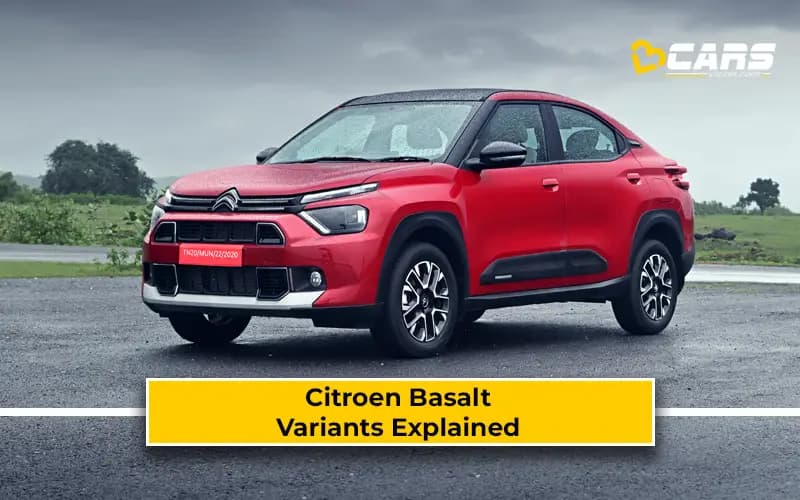
Updated (Aug 21, 2024): This update of the 2024 Citroen Basalt petrol variants explained article includes the August 2024 prices. Our buying recommendation in this article is based on the value for money and ownership experience.
Also Read: Tata Curvv 2024 — Variant-Wise Features (Curvv Petrol, Diesel)
What Are The Pros And Cons Of The 2024 Citroen Basalt?
The pros or advantages of Citroen Basalt 2024 are:
- Mouth-watering base price of just Rs. 7.99 lakh for a big and stylish C-segment SUV
- Unique body style in a hot and (still) growing C-SUV segment; its sloping roofline will continue to turn heads at least for the next few years as it has phenomenal road presence despite smaller dimensions on paper
- Comfortable ride quality with a feeling of connection with the machine while driving
- Respectable ARAI fuel efficiency figures of 18.0 - 19.5kmpl
- Spacious cabin has adequate head and knee room even for 6-footers
- Enormous, 470-litre boot space is large enough to easily accommodate weekend luggage for 4
- Unique and clever adjustable under-thigh support for 2 rear occupants
- Unlike before, where even the top variants felt like they were missing several features, this time around, the Basalt top variant comes across as more complete as it addresses most of the complains we have had for a while with Citroen cars
The 2024 Citroen Basalt has the following shortcomings or problems:
- Base variant lacks several must-have features we expect from a car at this price point regardless of the segment and body style
- Mid and top variants come across as highly overpriced with respect to the base variant; the Plus non-turbo only justifies about 43% of the incremental cost over the base model
- Poor real-world city mileage and thus a wider variation between city and highway mileage figures; we expect the Basalt to deliver high single digits in the city traffic
- Limited emotional features — for a car playing the emotional card with a coupe SUV body style, the lack of emotional features like larger 17-inch alloy wheels, sunroof, LED lights in cabin and cruise control feel like a big miss; moreover the flap type door handles also affect the beautiful side profile of the car
- Even the top model misses out on several must-have features we expect from a car at this price point such as telescopic steering, cruise control, sunroof, split-folding rear seatbacks and keyless entry with push-button start/stop
- Adjustable under-thigh support is only available with the Max turbo petrol-automatic
- Tiny sales and service network compared to the legends like Maruti Suzuki and Hyundai
What Is The Price Of 2024 Citroen Basalt Petrol Variants?
The new Citroen Basalt 2024 available in 3 main variants - You, Plus and Max. The 1.2L normal petrol engine with 5-speed manual transmission is available in You and Plus variants with prices ranging between Rs. 7.99 lakh and Rs. 9.99 lakh (ex-showroom), respectively.
The turbo petrol engine carries a premium of Rs. 1.50 lakh over the normal petrol engine. The 1.2L turbo petrol engine with 6-speed manual and 6-speed automatic transmissions are only available in Plus and Max variants. It costs between Rs. 11.49 and Rs. 13.62 lakh. The automatic transmission carries a premium of about Rs. 1.34 lakh over the manual transmission.
Citroen Basalt You — Base Model Standard Features
The base You variant of the Citroen Basalt costs Rs. 7.99 lakh (ex-showroom) and only comes with the 1.2L normal petrol engine and a 5-speed manual transmission. It gets the following notable features:
The base variant seems to miss out on the following important notable features:
- Music system
- Body-coloured mirrors and door handles
- Tilt steering
- TPMS
- Rear power windows
- Remote central locking
- Power mirrors
- Adjustable front headrests
- Day/night inside mirror
- Split folding rear seatbacks
With the base model of Citroen Basalt, you may miss out on many several must-have features like music system, TPMS, rear power windows,etc. The price jump to the reasonably-loaded mid variant is quite steep. So, it’s not worth compromising a great deal for them. If you are okay with aftermarket accessories and looking for a coupe SUV on a tight budget then this variant is worth buying.
2024 Citroen Basalt You vs Plus Variant — Feature Comparison
The next variant of the Citroen Basalt is the Plus, which is available with all 3 powertrain options:
- Normal petrol-manual
- Turbo petrol-manual
- Turbo petrol-automatic
The higher Plus variant costs between Rs. 9.99 lakh and 12.79 lakh. The Plus variant of the Basalt with normal petrol engine is Rs. 2.0 lakh costlier than the base You trim. If you buy the Plus variant with turbo petrol engine, it will cost you Rs. 1.50 lakh more than normal petrol engine. With the turbo petrol-automatic powertrain, you will have to pay another Rs. 1.30 lakh.
In addition to the normal petrol-manual powertrain, the Plus variant also offers the option of turbo petrol-manual and turbo petrol-automatic powertrains. It offers the following additional notable features:
The following features of the Basalt Plus are exclusively available with the turbo petrol engine:
The Basalt Plus turbo variant misses out on the following notable features:
- Rear camera
- Telescopic steering
- Keyless entry with push-button start/stop
- Split folding rear seatbacks
For non-turbo Plus variant buyers, The additional features don't even come close to justifying the incremental cost of Rs. 2.0 lakh over the base model. So, we don’t recommend this variant as it offers pathetic value for money. You should pick the base model over this variant or stretch your budget for a higher variant.
The turbo Plus variant buyers, this variant is not recommended. According to our custom algorithm, this variant offers poor value for money. We recommend you to skip this variant and upgrade to the top Max variant for a better value proposition.
New Citroen Basalt Plus vs Max Variant — Feature Comparison
The top variant of the Citroen is the Max variant, which offers a turbo petrol engine with manual and automatic transmissions. It costs Rs. 12.28 lakh which is Rs. 79,000 more expensive than the lower Plus trim.
The Max variant will cost you Rs. 12.28 lakh with manual transmission and Rs. 13.62 lakh with automatic transmission, which is Rs.1.34 lakh costlier than the manual transmission.
The Basalt Max variant only offer the turbo petrol engine option with manual and automatic. It offers the following additional features over the Plus turbo variant:
You may miss the following features in the Max variant:
- Telescopic steering
- Keyless entry with push-button start/stop
- Split-folding rear seatbacks
- Cruise control
- Sunroof
Even with so many good-to-have features, the Basalt top model still falls short of justifying the incremental cost over the base model by about 25%. So, we can’t openly recommend this either. However, if you’re okay with compromising a bit on the value front, then the Max (manual/automatic) is the only Basalt turbo variant we’ll suggest you consider.
Which Variant Of The Citroen Basalt Petrol Should You Buy?
First, you need to assess your driving requirements. If you don't drive much and you value the car's style and road presence more important than its features, then you should consider one of the normal petrol variants.
However, if you drive a lot, especially on the highways, then you should opt for the turbo petrol variant. Moreover, if you frequently drive in the city traffic, then an automatic transmission is a better option for you. Finally, if you want your car to have decent features, then the turbo petrol variants are the only ones suitable for you as the normal petrol engine is not available in the top variant.
For Basalt non-turbo buyers, the base variant earns our top recommendation while it doesn’t have several must-have features but it offers better value for money. We don’t recommend the mid variant of the Basalt as it only somewhat makes up for the barebones nature of the Basalt base model. The mid variant is significantly pricier than the base model and doesn’t justify the incremental cost. Therefore, we recommend you to downgrade to the base variant and add some aftermarket accessories.
For buyers who are looking for a turbo option, the only variant worth considering is the Max variant of the Basalt as it offers better value for money than the mid Plus variant. The recommendation for the automatic buyers is the same as the automatic transmission is only offered with the turbo engine.
What Are The Engine Specifications Of The Citroen Basalt Petrol?
Among the C-segment SUVs with a non-turbo petrol engine, the Basalt comes with the smallest 1.2L engine, which obviously produces the least power and torque. In this comparison, Basalt is the only car with a 3-cylinder engine, and it's also the only one that doesn't offer the option of an automatic transmission. This cost-saving is reflected in its starting price, as it is available from an attractive starting price of Rs. 7.99 lakh ex-showroom.
Amongst the rivals with a small turbo petrol engine, the Basalt turbo seems quite comparable. Here, the Basalt's torque of 190-205Nm is about what you’d expect from a car with a 1.2L turbo petrol engine. Even in terms of ARAI fuel efficiency, its numbers are quite respectable.
You can use our Fuel Cost Calculator to see how much any petrol, diesel or CNG car will cost to run based on the latest fuel price in your city.
What Are The Dimensions Of The 2024 Citroen Basalt?
Compared to other C-segment SUVs, you'll notice that the Basalt’s height and ground clearance are the lowest, and its width is only better than that of the Kushaq and Taigun. However, when you see it in person, it doesn't appear small. At first glance, the Basalt gives the impression of having high ground clearance, and you can’t tell that it has the lowest ground clearance in the segment. You can't judge its road presence just from the comparison table — it looks bigger than it actually is. Inside too, the Basalt has good legroom and headroom.
With 470 litres of boot space, the Basalt outshines its competitors. In contrast, the hybrid variants of the Grand Vitara and Hyryder offer only 265 litres of boot space, which is what you generally get from a small hatchback. However, both of these cars also come with 17-inch wheels as standard, while the Basalt only offers 16-inch alloys even in the top model.
*Estimated
Find out how you can get the best mileage or fuel efficiency from your car:
10 Tips To Get Better Mileage From Your Petrol, Diesel Or CNG Car
What Are The Colour Options Of The Citroen Basalt 2024?
The 2024 Basalt is available in the following 5 monotone colour options:
- White
- Silver
- Grey
- Red
- Blue
In addition, you also has the option of buying the Basalt in the following 2 dual-tone colours:
- Red with black roof
- Blue with black roof
To find out the variant-wise colour options of the Basalt, you can visit the following link:
2024 Citroen Basalt Variant-wise Colour Options
Note: Here is a quick look at our length-based segmentation of cars to give you an idea of how we are classifying cars based on their size.
You can read more about vehicle segmentation at the following link: