

Published : 08 May 2023
Read Time : 5 min
Author: Mahesh Yadav
In this variant explained article, you'll find out which variant of the Maruti Suzuki Ignis petrol you should buy based on the ex-showroom prices, variant-wise features and value for money. Here we compare and objectively analyse the Ignis's petrol variants and the features to figure out which variant is worth buying for a good value for money and ownership experience. Then we will compare the engine specs, dimensions and mileage of the Maruti Suzuki Ignis with other petrol-powered SUVs and crossovers like Tata Tiago NRG, Tata Punch and the normal petrol variants of the Maruti Suzuki Fronx, Citroen C3, Nissan Magnite and Renault Kiger.
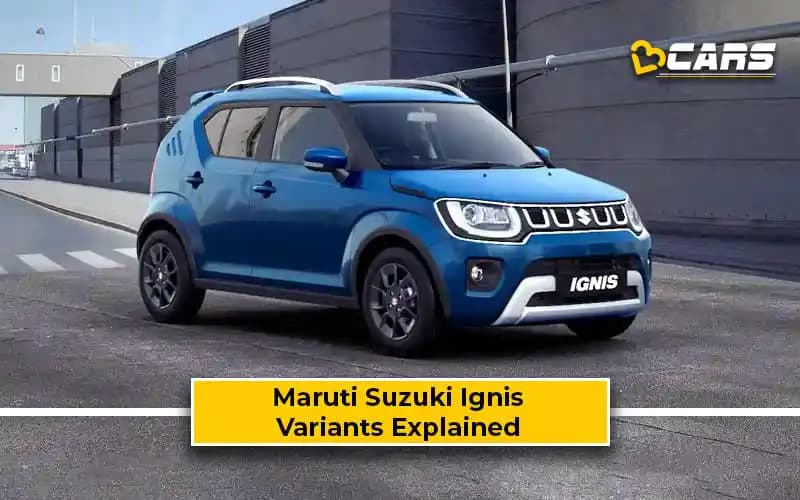
Updated: Maruti Suzuki recently updated the prices of the Nexa Ignis. This update of the Maruti Ignis variants explained includes the latest prices and buying recommendations for each variant.
Also Read: Citroen C3 Variants Explained - Which One To Buy?
Tata Punch Petrol Variants Explained - Which One To Buy?
What Are The Pros And Cons Of Maruti Suzuki Nexa Ignis Petrol?
The pros or advantages of Maruti Nexa Ignis are:
- SUV-like ground clearance of 180mm
- Compact dimensions, high ground clearance and high seating position make it the perfect tool for driving in the city
- Class-leading official mileage figure of almost 21kmpl
- Maruti Suzuki’s wide service network makes it easy to find original or OEM-spec spares and competent mechanics
The Maruti Suzuki Ignis petrol has the following shortcomings or problems:
- No CNG and turbo petrol engine options
- No 1.2L dual-jet engine update yet; hence a lower mileage figure than other 1.2L petrol cars in Maruti’s portfolio
- Missing features like front and rear armrest, rear AC vents, cruise control and TPMS
- Being a Nexa exclusive model limits the reach of the Ignis
- Overpriced Delta variant offers poor value for money - Addressed by Maruti Suzuki with price revision
What Is The Price Of Maruti Suzuki Nexa Ignis Petrol Variants?
The Maruti Suzuki Ignis is available in 4 variants with a starting price of Rs. 5.84 lakh for the Sigma petrol-manual and the prices stretch up to Rs. 7.61 lakh for the Alpha petrol-manual. The top-end Alpha variant with the petrol-automatic powertrain costs Rs. 8.16 lakh (ex-showroom). The AMT automatic transmission is available in the top 3 variants. The price difference between the manual and automatic variants is constant at Rs. 55,000.
Maruti Suzuki Ignis Petrol Sigma - Base Model Features
The base model of the Maruti Suzuki Ignis is only available with a petrol-manual powertrain and costs Rs. 5.84 lakh. The Ignis Sigma has the following notable features:
- Tilt steering
- Adjustable front headrests
- Body-coloured bumpers, door handles and outside mirrors
- 15-inch steel wheels
- Dead pedal/driver foot rest
- Front power windows
The base variant doesn’t get the following important features:
- Day/night inside mirror
- Internally-adjustable outside mirrors
- Wheel covers
- Music system
- Steering-mounted controls
- Remote central locking
- Rear power windows
Since the base variant doesn’t get several must-have features, you’ll have to make huge compromises during the ownership or get aftermarket accessories. We’ll suggest budget buyers spend a bit more and get a higher variant.
Maruti Suzuki Ignis Petrol Sigma vs Delta Variant - Price, Features Comparison
The Maruti Suzuki Ignis Delta costs Rs. 6.38 lakh with the manual and Rs. 6.93 lakh with the automatic. The AMT automatic transmission carries a premium of Rs. 55,000 over the manual and this price difference is consistent across all variants. The Delta variant is Rs. 54,000 more expensive than the Sigma. For Ignis automatic buyers, this is the most affordable variant.
Over the base Sigma variant, it adds the following notable features:
- Music system
- Steering-mounted controls
- Remote central locking
- Rear power windows
- Split rear seatbacks
- Wheel covers
- Wheel arch cladding
- Dual-tone dashboard
- Power mirrors
- Tachometer
- Boot light
- Day/night inside mirror
While the Delta variant covers the basics quite well, you may still miss the following features in this variant:
- Touchscreen
- Rear washer wiper
- Rear defogger
- Auto AC
- Height-adjustable driver seat
While it’s missing a few features, we’ll still suggest budget buyers to accommodate at least the Delta variant for a decent ownership experience. In terms of value, it justifies the incremental asking price. If you can stretch your budget further, then the Zeta is a better option in terms of value as well as ownership experience. But for budget buyers, it’s a good value option, which covers the basics quite well.
Maruti Suzuki Ignis Petrol Delta vs Zeta Variant - Price, Features Comparison
The Maruti Suzuki Ignis Zeta costs Rs. 6.96 lakh with the manual and Rs. 7.51 lakh with the automatic. The Zeta variant is Rs. 58,000 more expensive than the Delta.
It adds the following notable features over the Delta variant:
- 7-inch touchscreen
- Wired Android Auto and Apple Carplay
- 2 extra speakers and 2 tweeters
- Fog lamps
- Power folding mirrors
- Keyless entry with push-button start/stop
- 15-inch alloy wheels
In this variant, you may miss features like:
- Auto AC
- Front armrest
- Rear AC vents
- Height-adjustable driver seat
- LED or projector headlamps
- Rear camera
- TPMS (Tyre pressure monitoring system)
Because of some high-value features like touchscreen and alloy wheels, the Zeta variant more than justifies the incremental cost over the lower variants and offers the best value for money. For this reason, the Zeta variant is our top recommendation for all Ignis petrol-manual and petrol-automatic buyers.
Maruti Suzuki Ignis Petrol Zeta vs Alpha Variant - Price, Features Comparison
The Maruti Suzuki Ignis Alpha variant costs Rs. 7.61 lakh with the manual and Rs. 8.16 lakh with the automatic. It’s Rs. 65,000 more expensive than the Zeta trim and gets the following notable additional features:
- LED projector headlamps
- LED DRLs
- Auto AC
- Puddle lamps
- Rear camera
- Height-adjustable driver seat
Even in the well-loaded Alpha trim, you may miss features like:
- Cruise control
- Front armrest
- Rear armrest
- Rear AC vents
- TPMS (Tyre pressure monitoring system)
The Alpha variant justifies the incremental cost over even the base Sigma variant, but it doesn’t offer the kind of value for money that the Zeta does. The Alpha is a value for money variant. However, you should buy it only if you can easily afford this variant and absolutely want these features.
Which Variant Of The Maruti Nexa Ignis Petrol Should You Buy?
The base Sigma variant of the Maruti Nexa Ignis misses out on several must-have features and will provide a poor ownership experience. So, we don’t recommend buying the base Sigma variant of the Nexa Ignis. The next Delta variant is a value upgrade and offers many must-have features. So, we’ll suggest budget buyers to buy at least the Delta variant.
However, if you can afford a higher variant, then the Zeta is our top recommendation. It offers the best value for money because of high-value features like alloy wheels, touchscreen and keyless entry.
The top Alpha variant is also a value upgrade but, in our opinion, it’s only for those who can easily afford it and want those extra features.
What Are The Engine Specifications Of The Maruti Suzuki Ignis Petrol?
In terms of engine specs, the performance of the Ignis is on par with other 1.2L normal petrol crossovers like the Tiago NRG, Tata Punch, Fronx and Citroen C3. However, its torque-to-weight ratio is the best in class.
Given its relatively light weight and decent torque output, you can expect Ignis to offer better drivability than the Punch,Fronx, Magnite, Kiager, C3 and Tiago NRG. The Tiago NRG also has a respectable figure of 20.09kmpl and is only 0.8kmpl shy of the Ignis’ mileage. The C3, Magnite, Kiger and Fronx also have the option of a turbo petrol engine, which we’ve not included in this comparison.
*Estimated
What Are The Dimensions Of The Maruti Suzuki Ignis?
In terms of dimensions, the C3, Magnite, Kiger and Fronx are larger, B2 segment cars. The Fronx, Kiger and Magnite are the widest cars in this comparison while the Magnite and Kiger hold the top spot in terms of ground clearance. Meanwhile, the Ignis sits towards the bottom of this list in width as well as ground clearance. The Magnite, Kiger and Fronx also have the biggest, 16-inch wheels with the widest tyres.
The Ignis, Tiago NRG and C3 have comparable ground clearances while the Punch offers a slightly better clearance. The Ignis and Tiago NRG have comparable tyre sizes while the C3 and Punch offer wider tyres. The Ignis offers middle-of-the-road 15-inch wheels as standard while the NRG has the smallest 14-inch wheels in the lower variants.
What Are The Colour Options Of The Maruti Suzuki Ignis?
The Ignis is available in the following 7 colours:
- White
- Silver
- Grey
- Blue (not available in base variant)
- Orange (available only in top 2 variants)
Note: Here is a quick look at our length-based segmentation of cars to give you an idea of how we are classifying cars based on their size.
Also Read: Car Segments Explained - With Body Styles And Examples