

Published : 25 March 2026
Read Time : 5 min
Author: Mahesh Yadav
In this variant explained article, you'll find out which variant of the 2026 Tata Punch EV facelift you should buy based on the prices, variant-wise features and value for money. Here we compare and objectively analyse the new Punch EV's variants and their features. Then we will compare the electric motor specs, range, battery capacity and dimensions of the Tata Punch EV with its competitors like the Citroen eC3 and also the Nexon EV.
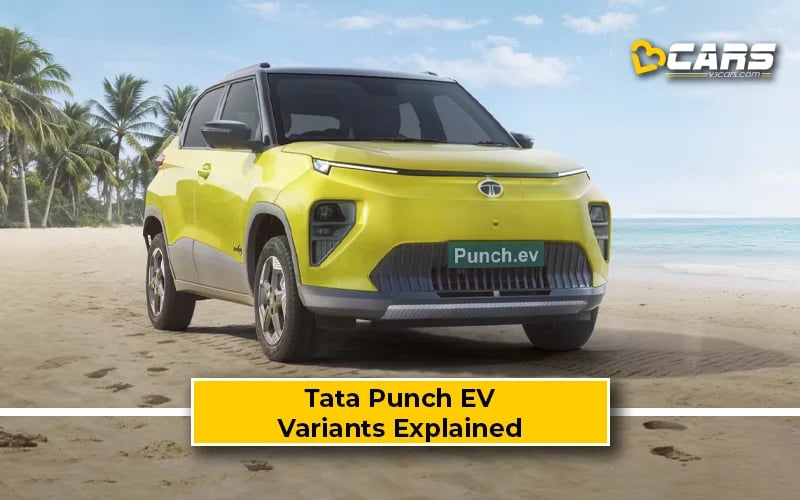
Update (March 25, 2026): This update of the Tata Punch EV variants explained includes the buying recommendations for the 2026 Punch EV facelift.
Also Read: 2026 Maruti Suzuki E Vitara Variants Explained — Which One To Buy?
What Are The Pros And Cons Of The 2026 Tata Punch EV?
The pros or advantages of Tata Punch EV 2026 are:
- Punch EV brings a distinct styling over the regular Punch and helps it stand out
- With a 40kWh battery pack, it’s the most affordable EV with 300km+ real-world range
- Excellent value for money pricing across the board; 40kWh variants offer outstanding value for money score for the incremental cost over the base model
- Fairly long list of standard safety features such as 6 airbags, HSA, ESC, LED headlamps, TPMS, height-adjustable driver seat, front and rear adjustable headrests, auto AC
- 5-star safety rating
- Innovative safety features such as using side cameras as blind view camera and high-beam alert improve real-world safety as they help prevent accidents
- Lifetime battery warranty for first owner (up to 15 years) with Punch EV 40 variants
- Rather than an electric version of the Punch, the Punch EV feels like a different car altogether from the front, inside and while driving — No longer applicable after Punch petrol/CNG 2026 update
The 2026 Tata Punch EV has the following shortcomings or problems:
- Rear AC vents not available in any variant
- Feature distribution is poor in the mid variants as they lack some must-have features
- 6-month/7,500km service interval is insanely short for any modern car, especially an EV, which doesn’t even need oil and filter changes
- Lifetime battery warranty doesn’t apply to the 30kWh battery variants
- Tata’s first attempt at making an EV-specific platform (hardware as well as software) may result in niggles and long-term reliability problems, which may start pinching more once the warranty expires — Not a serious concern with the new Punch EV
- Top model on-road price of Rs. 16.0 - 18.0 lakh in some states with minimal-to-no subsidies in EV registration may be difficult to digest for a sub-compact B1-segment car — Addressed with 2026 update as top model ex-showroom prices have come down from Rs. 14.50 lakh to Rs. 12.70 lakh; a massive drop of Rs. 1.80 lakh since the Punch EV was first introduced in early 2024
- Falling EV prices may result in buyer’s remorse should the Punch EV prices drop further; they have already dropped by more than Rs. 1.0 lakh since the car went on sale — No longer a concern as Punch EV 2026 prices now seem reasonable with much less risk of falling much from here
- Fairly high km-to-breakeven of about 1,00,000km over the comparably-loaded variant of the regular Punch petrol-automatic — Addressed with 2026 Punch EV update; now, the km-to-breakeven figure is less than 50,000km with home charging compared to 2026 Punch CNG-automatic top variant (even if using low CNG prices in Delhi for calculation)
- Rear armrest not available even in the top model of the medium range variants — Addressed by Tata Motors in Jan 2025 update)
What Is The Price Of Tata Punch EV Variants?
The Tata Punch EV is available in 5 main variants — Smart, Smart Plus, Adventure, Empowered and Empowered Plus S with primarily 2 options similar to powertrain options in a typical engine car:
- 30kWh: This battery pack is only available in the lower 2 variants — Smart and Smart Plus — with an ex-showroom price of Rs. 9.69 lakh and Rs. 10.29 lakh, respectively.
- 40kWh: The larger battery pack is available in all variants except the Punch EV base model. Punch 40 variants cost between Rs. 10.89 lakh and Rs. 12.59 lakh (ex-showroom).
Note: Check your Car EMI with our - Car EMI Calculator
Tata Punch EV Smart 30 — Base Model Standard Features
The base model of the Tata Punch EV is only available with the smaller, 30kWh battery pack and costs Rs. 9.69 lakh (ex-showroom). The most notable features of the Punch EV’s base model are:
Considering the price of the Punch EV base model, you may miss the following features:
- Touchscreen/music system
- Day/night inside mirror
- Steering-mounted controls
- Body-coloured door handles
- Body-coloured or painted outside mirrors
- Power mirrors
- Front armrest
- Rear armrest
- Rear defogger
- Rear parcel tray
- Rear power windows
- Rear AC vents
Not only does the Punch EV base model miss out on several features we expect from a car costing close to Rs. 10.0 lakh ex-showroom, the higher variants also have more features and better value for money. So, the Punch EV base variant is not recommended.
2026 Tata Punch EV Smart 30 vs Smart Plus 30 & 40 Variant — Price, Feature Comparison
Besides the smaller 30kWh battery pack, the higher Smart Plus variant of the Punch EV also gets the larger 40kWh battery option. Smart Plus 30 costs Rs. 10.29 lakh, which is Rs. 60,000 more than the Smart 30. Meanwhile, the Smart Plus 40 costs Rs. 10.89 lakh, which is another Rs. 60,000 higher than the Smart Plus 30.
The Smart Plus variant of the Punch EV gets the following additional notable features over the base Smart base model:
In this variant, you may miss features like:
- Body-coloured door handles
- Body-coloured or painted outside mirrors
- Power mirrors
- Cruise control
- Front armrest
- Rear armrest
- Rear defogger
- Rear parcel tray
- Rear AC vents
Besides offering less range, the Smart Plus 30 also misses out on several features, which are available in the Smart Plus 40 variant. Since the cost of upgrading to the Smart Plus 40 is only another Rs. 60,000, this variant becomes an easy recommendation for budget conscious buyers. Even if you don’t intend to do long drives and intend to use the Punch EV only for city driving, you’ll still appreciate the longer range as you’ll have to plug in the car less often.
Tata Punch EV Smart Plus 40 vs Adventure 40 Variant - Price, Feature Comparison
The Adventure onwards, all Punch EV variants only get the 40kWh battery pack option. The Adventure 40 variant costs Rs. 11.59 lakh, which is Rs. 70,000 higher than the Smart Plus 40.
The Adventure variant of the Punch EV gets the following additional notable features over the base Smart Plus variant:
In the Adventure 40 variant of the Punch EV, you may miss features like:
- Front armrest
- Rear armrest
- Rear defogger
- Rear parcel tray
- Rear AC vents
- Rear washer wiper
- Wireless Android Auto and Apple Carplay
While the Adventure 40 gets many of the must-have features and even more than justifies the price gap over the base trim, we’d suggest stretching your budget for a higher variant. Empowered 40 will not only feel more complete in terms of feature distribution, it also offers much better value for money over the Adventure 40 and more than justifies spending another Rs. 70,000.
Tata Punch EV Adventure 40 vs Empowered 40 Variant — Price, Feature Comparison
The Punch EV Empowered variant costs Rs. 12.29 lakh and it’s Rs. 70,000 pricier than the lower Adventure 40 variant.
The Empowered variant of the Punch EV gets the following additional notable features over the base Adventure variant:
The Empowered 40 misses out on the following features:
- Rear armrest
- Rear AC vents
If, like me, you hate features such as leather upholstery and sunroof, then this variant is for you. It has a 142% VFM score — as in it offers features worth 42% more than the cost of upgrading from the base model. While some of them may not be on your list of preferred features, considering only the must-have features will also justify the jump from Smart 30 to Empowered 40.
However, for an extra Rs. 30,000, the Empowered Plus S 40 adds a bunch more features. Considering the nominal incremental cost and the fairly long list of features, this could be an impulsive upgrade for most Punch EV buyers.
Tata Punch EV Empowered 40 vs Empowered Plus S 40 Variant — Price, Feature Comparison
The Empowered Plus variants of the Tata Punch EV cost exactly Rs. 20,000 higher than the Empowered variants.
The Punch EV’s Empowered Plus 40 variant gets the following notable additional features over the Empowered 40 trim:
Even in the Punch EV top model, you may miss rear AC vents, which are available in lower variants of the much more affordable cars such as the Grand i10 Nios.
From a value angle, the Empowered Plus S 40 is the best option offering an impressive 155% VFM score. The value for money over the Empowered 40 variant is so good, that even if you don’t like good-to-have features such as sunroof and leather upholstery, the jump to Empowered Plus S feels like an obvious upgrade. So, the Punch EV top model earns our top recommendation with ease.
Which Variant Of The Tata Punch EV Should You Buy?
For budget conscious buyers, the base variant is not such a good deal. In fact, you should skip both the 30kWh variants and buy at least the Smart Plus 40. However, if your budget is elastic, then the Empowered Plus S 40 is an easy choice and our top recommendation. The Empowered 40 is a good choice only for buyers who absolutely hate some good-to-have features such as leather upholstery and sunroof. A little more affordable, Adventure 40, variant offers a nice balance of features and is worth considering but the higher variants offer better value. So, you should strongly consider upgrading to Empowered 40 or Empowered Plus S 40.
What Are The Engine or Motor Specifications Of The New Tata Punch EV 2026?
In terms of the specifications, the Punch EV offers 2 battery configurations — 30kWh and 40kWh. Both battery options are 5kWh batter than the older Punch EV and promise longer ranges.
All Punch EV variants are capable of DC fast charging using a CCS2 gun and AC slow charging with a Type-2 gun. It can benefit from a DC fast charger of up to 65kW power output. On the slow AC charging side, the Punch EV can accept up to 7.2kW of power while the bundled portable charger with the car has a rated power output of 3.3kW.
The Punch EV now has 370km of claimed range with the smaller battery pack and 464km from the larger battery pack. In real world driving, you can expect the Punch EV 30 to give you around 260km while the larger battery pack can deliver around 320km of range.
With its larger battery pack, the Punch EV offers similar range as the Nexon EV 45, which is worth highlighting. On the performance side, the Punch EV 30 has 88PS of power while the 40kWh variants offer 129PS of peak power output. The torque figure, though, remains consistent at 154Nm regardless of the battery option you choose.
With the 2026 update, the Punch EV is suddenly starting to look like a solid choice among smaller affordable EVs.
*Estimated
**Real world mileage is calculated based on estimated real world range and includes a typical 15% transmission losses during charging
You can use our Fuel Cost Calculator to see how any petrol, diesel or CNG car will cost to run based on the latest fuel price in your city.
What Are The Dimensions Of The Tata Punch EV?
In terms of dimensions, the Tata Punch EV 2026 is much smaller than the EC3 and Nexon EV. This can be good news for buyers who want a small EV with a healthy real-world range. If it’s road presence you want, then the EC3 and Nexon EV are better options.
The EC3’s low ground clearance measuring only 170mm should be a cause for concern as it falls short of the minimum 180mm, we consider necessary for a car to earn the SUV tag. The Punch EV sits comfortably high off the ground with its 195mm ground clearance.
Find out how you can get the best mileage or fuel efficiency from your car:
10 Tips To Get Better Mileage From Your Petrol, Diesel Or CNG Car
What Are The Colour Options Of The 2026 Tata Punch EV?
The Punch EV is available in the following 4 monotone and 3 dual-tone exterior colours:
- White
- Red
- Grey
- Brown
- Orange with black roof
- Pastel green with black roof
- Neon yellow with black roof
To find out the variant-wise colour option availability of the Punch EV, you can visit the following link:
2026 Tata Punch EV – All Exterior Colour Options (Variant-Wise)
Note: Here is a quick look at our length-based segmentation of cars to give you an idea of how we are classifying cars based on their size.
You can read more about vehicle segmentation at the following link: