

Published : 02 December 2022
Read Time : 5 min
Author: Mahesh Yadav
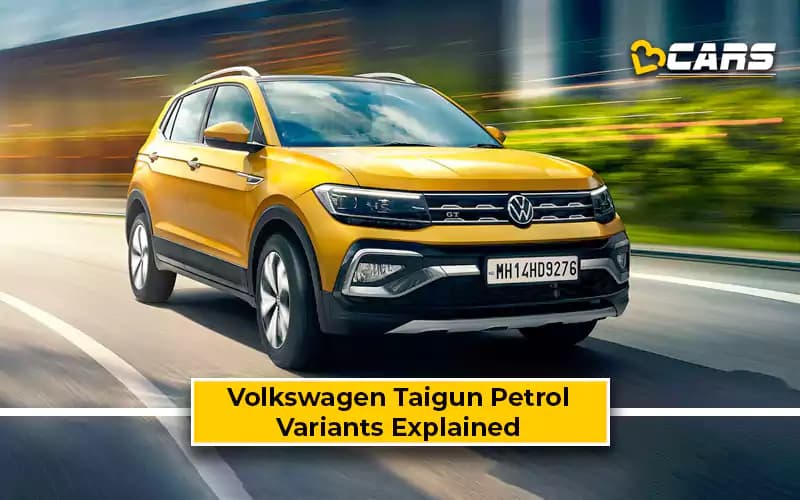
In this variant explained article, you'll find out which variant of the Volkswagen Taigun petrol you should buy based on the price, variant-wise features and value for money. Here we compare and objectively analyse the 2022 Taigun's petrol variants and their features. Then we will compare the engine specs, dimensions and mileage of the 2022 Volkswagen Taigun with its competitors and other petrol-powered C-segment SUVs like Skoda Kushaq, MG Astor, Hyundai Creta, Kia Seltos, Toyota Hyryder and Maruti Nexa Grand Vitara.
Updated: This Volkswagen Taigun variants explained article includes the buying recommendations based on the latest December 2023 prices.
Also Read: Kia Seltos Petrol Variants Explained - Which One To Buy?
Toyota Urban Cruiser Hyryder Petrol Variants Explained - Which One To Book?
Maruti Suzuki Grand Vitara Petrol Variants Explained - Which One To Book?
What Are The Pros And Cons Of Volkswagen Taigun Petrol?
The pros or advantages of Taigun petrol are:
- 1.0L turbo petrol engine has a better torque curve and output than the base 1.5L normal petrol engines available in the segment
- Because of the sub-1.0L displacement, this engine will save you some cash on insurance every year
- The Taigun gets a decent list of features like ventilated seats, colour LCD instrument cluster, cruise control, sunroof, 3-point seatbelts for all occupants and TPMS
- 1.5L turbo petrol engine gets fuel-saving cylinder-deactivation technology
- Good-to-excellent fuel efficiency figures for both petrol engines are either better or on par for the segment and only beaten by the Grand Vitara and Hyryder
The Volkswagen Taigun petrol has the following shortcomings or problems:
- The Taigun is small and lacks the road presence we expect from a C-segment SUV
- Torque converter-type automatics are generally gas guzzlers because of their fluid coupling, especially in stop-and-go traffic and the 1.0L petrol-automatic’s fuel efficiency figure reflects the same
- The 1.5L engine gets a dual-clutch automatic transmission; DCTs are yet to prove their long-term reliability
- No seat ventilation in the top-spec GT Plus variant; it’s available in the Topline 1.0L - Addressed by Volkswagen November 2022
- No manual transmission option in the somewhat reasonably-priced GT Plus variant
- Missing features like powered driver seat, front parking sensors, 360-degree camera, panoramic sunroof, subwoofer, ADAS, head-up display, soft-touch dashboard and blind spot monitor
What Is The Price Of Volkswagen Taigun Petrol?
The Volkswagen Taigun is available with 2 turbo petrol engines, and both of these get a manual and an automatic transmission. The 1.0-litre turbo petrol engine is Taigun’s mainstay as it’s available in 3 variants with the option of automatic transmission in 2 of these. The Taigun 1.0L turbo manual starts at Rs. 11.56 lakh and tops out at Rs. 15.66 lakh. The 2 Taigun 1.0L automatic cost Rs. 14.96 and Rs. 17.16 lakh. The automatic is Rs. 1.40 to 1.50 lakh more expensive than the manual.
The more powerful 1.5-litre turbo petrol engine is available in GT and GT Plus variants. The GT gets only the manual transmission and costs Rs. 15.96 lakh. The Volkswagen Taigun GT Plus is available only with the dual-clutch automatic and costs Rs. 18.71 lakh (ex-showroom). There’s also an option of getting this with the ventilated seats feature for an additional Rs. 25,000.
Volkswagen Taigun Petrol Comfortline - Base Model Features & Review
The Taigun’s base Comfortline variant with the 1.0L turbo petrol engine and manual transmission costs Rs. 11.56 lakh. It gets a few notable features like:
- 16-inch steel wheels with covers
- Front differential lock
- 3-point seatbelts for all passengers
- Front armrest
- LED DRLs
- LED tail lamps
- All power windows
- Power mirrors
- Fabric upholstery
- 7-inch touchscreen infotainment
- Android Auto and Apple Carplay
- Steering-mounted controls
- Side cladding
- Manual AC with rear AC vents
- Tyre pressure monitoring system (TPMS)
- Remote central locking
The base variant itself covers the basic features very well. However, you may miss the following features, which are available in the Highline variant:
- Rear defogger
- Rear washer wiper
- Rear camera
- Front fog lamps
- 16-inch alloy wheels
- Rear armrest
- Rear parcel tray
- Height-adjustable driver seat
- Power folding mirrors
- Auto AC
The price jump to the Highline variant is too steep to justify an upgrade. If you can manage without these features and want better value for money, then we don’t see the need to jump to the Highline variant.
Volkswagen Taigun Petrol Comfortline vs Highline Variant - Price, Feature Comparison
The price difference between the Taigun Comfortline and Highline variant is Rs. 2.0 lakh and it costs Rs. 13.56 lakh (ex-showroom) with the manual transmission. With an ex-showroom price of Rs. 14.96 lakh, the Taigun Highline automatic is Rs. 1.40 lakh more expensive than the Highline manual.
For the additional Rs. 2.0 lakh, you get the following notable features:
- Split rear seatback
- Larger 10-inch touchscreen
- Wireless connectivity for Android Auto and Apple Carplay
- Rear defogger
- Rear washer wiper
- Rear camera
- Front fog lamps
- 16-inch alloy wheels
- Rear armrest
- Rear parcel tray
- Height-adjustable driver seat
- Wireless phone charger
- Power folding mirrors
- Auto AC
- Ambient lighting
- Cruise control (only available with automatic)
Most of these features are a straight-up must-have for a lot of SUV buyers, but the price jump is difficult to justify. So, whether you want the Taigun with manual or automatic, we suggest you expand your budget and get the Topline variant or sacrifice some of these features and get the cheaper Comfortline trim. Highline is not a value for money option in the Taigun variant lineup.
For Taigun automatic buyers also, the jump to Topline is a more lucrative option. So, we can’t recommend the Highline automatic either.
Despite a big price jump for the Highline trim, you will still miss a few features like:
- LED of projector headlamps
- Cruise control (not available with manual transmission)
- Sunroof
- Keyless entry with push-button start/stop
Volkswagen Taigun Petrol Highline vs Topline Variant - Price, Feature Comparison
The price difference between the Taigun Highline and Topline manual variants is Rs. 2.10 lakh. The price gap between the Highline automatic and Topline automatic is slightly higher at Rs. 2.20 lakh. The Topline manual and automatic carry an ex-showroom price of Rs. 15.66 lakh and Rs. 17.16 lakh. The automatic transmission is Rs. 1.50 lakh more expensive than the Topline manual.
For the extra Rs. 2.20 lakh or so, you get extra features like:
- LED projector headlamps
- Auto wipers
- Cruise control (also available with manual transmission)
- Leather upholstery
- 17-inch alloy wheels
- Keyless entry with push-button start/stop
- Ventilated front seats
- Front side thorax and curtain airbags
- 8-inch colour LCD instrument cluster
- Electric sunroof
- Auto-dimming inside mirror
A good chunk of these features are strictly good-to-have, but at least on the value front, the Taigun 1.0L Topline justifies spending more cash upfront than the Highline trim. So, the Topline is a better choice for manual and automatic buyers if you want the Taigun with a reasonably long list of features.
Although, even in the Topline variant, you might miss feature like:
- Powered driver seat
- Panoramic sunroof
- Powered boot lid
- Head-up display
- Blind-spot monitor
- Front parking sensors
- Soft touch dashboard
- 360-degree camera
- ADAS features like adaptive cruise control, auto-emergency brake assist, collision warning, lane departure warning and lane keep assist
Volkswagen Taigun Petrol Highline vs GT Variant - Price, Feature Comparison
The Taigun GT and GT Plus variants get the more powerful 1.5L turbo petrol engine. The GT trim is similar to the Highline, but with a more powerful engine and a few extra features. So, it’s fair to compare the Taigun GT 1.5L with the Highline 1.0L.
The price difference between the Taigun Highline 1.0L manual and GT 1.5L manual variant is Rs. 2.40 lakh and it costs Rs. 15.96 lakh (ex-showroom). The Taigun GT is only available with a manual transmission.
For the additional Rs. 2.40 lakh, you get the larger 1.5L petrol engine with 35PS more power and 72Nm more torque. The Volkswagen Taigun GT’s power and torque output stand at 150PS and 250Nm, respectively. Since the larger engine has 4 cylinders compared to 3 cylinders in the smaller 1.0L engine, you can also expect it to drive more smoothly because of its inherently balanced nature.
This engine also gets cylinder deactivation, which cuts the fuel flow to 2 of the 4 cylinders. The ECU automatically enables cylinder deactivation when we’re cruising at a constant speed, and it doesn’t need the extra torque. This helps save some fuel while cruising at highway speeds of 80 - 100kmph, but it can also work at lower or higher speeds depending on the torque demand.
On top of the features available in the Taigun Highline, the GT also gets hill start, leather-fabric upholstery with contrast red stitching, red ambient lighting and GT badges.
Since the Highline variant itself is a poor value for money option, the GT also becomes difficult to recommend. This variant also doesn’t get features like cruise control, keyless entry, sunroof and LED projector headlamps. However, it’s the only variant you can buy with the larger 1.5L petrol engine and a manual transmission as the GT Plus only gets the automatic transmission.
Volkswagen Taigun Petrol GT vs GT Plus Variant - Price, Feature Comparison
The GT Plus variant is based on the Topline variant, and it’s only available with the 7-speed dual-clutch automatic transmission. The Taigun offers no choice for buyers who want all the bells and whistles along with the more powerful 1.5L turbo petrol engine and an engaging manual transmission.
Compared to the Taigun GT manual, the GT Plus automatic is Rs. 2.75 lakh more expensive and it costs Rs. 18.71 lakh (ex-showroom).
The Taigun GT Plus is also available in an optional variant with the ventilated seats, which are available in the 1.0L topline variant but not in the regular GT Plus. This higher variant costs 18.96 lakh and is Rs. 25,000 pricier than the GT Plus without the ventilated seats.
The notable additional features of the GT Plus over the GT variant are:
- LED headlamps
- Auto wipers
- Cruise control
- Leather upholstery
- 17-inch machined alloy wheels
- Keyless entry with push-button start/stop
- Side and curtain airbags
- 8-inch colour LCD instrument cluster
- Electric sunroof
- Auto-dimming inside mirror
- Dual-tone exterior
- Metal pedals
- Ventilated seats (Optional for Rs 25,000 extra)
The one feature, which is available in the Taigun 1.0L Topline and not available in the GT Plus is front seat ventilation. Other than that, from a value perspective, the Taigun GT Plus comes across as a better option than the GT manual. So, if you want to buy the Taigun with the more powerful 1.5L turbo petrol engine, then the GT Plus is our top choice.
Between the GT Plus normal and GT Plus optional variant with the ventilated seats, we’ll suggest getting the pricier optional variant. Because of the unbreathable leather seats, the ventilated seats become a must have feature, which will greatly improve your ownership experience. It’s especially important for buyers who live in hot or humid regions and it’s okay to pay the slight premium for this feature.
Which Variant Of The 2022 Volkswagen Taigun Petrol Should You Buy?
Let’s start with the Volkswagen Taigun manual transmission options. The base Comfortline variant of the Taigun with the smaller 1.0L turbo petrol engine is our top choice as the mid-spec Highline trim doesn’t justify the higher asking price. If the Comfortline is too basic for your preferences and you want more features, then we recommend spending a little more and getting the Topline variant. If you want more performance, then the Taigun GT is an option, but this one too doesn’t justify the asking price as it’s based on the Highline trim, which already offers a poor value for money. Considering the price of the Taigun GT, it’s also missing several features like cruise control, sunroof, keyless entry and LED projector headlamps.
For the Taigun petrol automatic buyers also, we don’t recommend the Highline trim as it offers poor value for money. You should instead buy the Topline 1.0L. If you want better performance, then the 1.5L GT Plus trim with the 7-speed dual-clutch automatic also is worth upgrading. Between the GT manual and GT Plus automatic, the more expensive GT Plus is a better choice from a value-for-money perspective.
If you are considering buying the GT Plus variant, then we strongly recommend buying the GT Plus with the front ventilated seats. The leather upholstery is not breathable like fabric. So, the ventilated seats will greatly improve your ownership experience especially if you live in hot or humid regions of the country. It’s worth noting that the Rs. 25,000 premium for this feature is a little high but ventilated seats are also a must have feature, especially if your car has leather seats.
What Are The Engine Specifications Of The Volkswagen Taigun Petrol?
The base 1.0-litre turbo petrol engine of the Volkswagen Taigun is the smallest in the segment, but its power output is on par for the segment and better than the Astor 1.5L. Since this is a turbo petrol engine, it makes better torque than all C-segment SUVs with a non-turbo petrol engine. Turbo petrols also have a wider torque curve, and they deliver their torque at low RPMs, which gives them great drivability for city driving. In the case of Taigun 1.0L, the peak torque arrives at 1750rpm and stays at 178Nm until 4500rpm.
This engine is also available with a 6-speed torque converter type automatic transmission. In terms of fuel efficiency, the Taigun 1.0L manual is better than Creta and Seltos but not as good as the mild-hybrid engines of the Grand Vitara and Hyryder. With the gas-guzzling torque converter automatic, the Taigun 1.0L gives a 16.44kmpl efficiency figure, which is considerably lower than the manual’s but still comparable with the rivals. In terms of fuel efficiency, the Grand Vitara hybrid automatic and Hyryder hybrid automatic are in a league of their own.
Most of Taigun’s rivals also have a more powerful turbo petrol engine available as an option. Taigun also has a 1.5-litre turbo petrol engine, which makes 150PS of power and 250Nm of torque. Both of these figures are on point for the segment. This engine is also available with a 7-speed dual-clutch automatic transmission. Amongst its powerful peers, the Taigun is the most fuel-efficient option with the manual as well as the automatic.
What Are The Dimensions Of The Volkswagen Taigun?
The Volkswagen Taigun is one of the smallest SUVs in the segment. It’s the shortest, and its length is comparable with only the Skoda Kushaq. However, the ground clearance is still acceptable at 188mm, which is better than the Astor’s.
*Estimated
What Are The Colour Options Of The 2022 Volkswagen Taigun?
The 2022 Taigun is available in the following 5 colour options:
- Yellow/Gold
- White
- Red
- Grey
- Silver
Note: Here is a quick look at our length-based segmentation of cars to give you an idea of how we are classifying cars based on their size.