

Published : 20 July 2025
Read Time : 5 min
Author: Saloni Chaudhary
In this variant explained article, you'll find out which variant of the Maruti Baleno you should buy based on ex-showroom prices, variant-wise features and value for money for a balanced ownership experience. Here we compare and objectively analyse the 2025 Baleno’s petrol and CNG variants and their features. Then we will compare the engine specs, dimensions and mileage of the 2025 Maruti Baleno with its competitors and other petrol and CNG-powered B2-segment hatchbacks like Hyundai i20, the new Tata Altroz and Toyota Glanza.
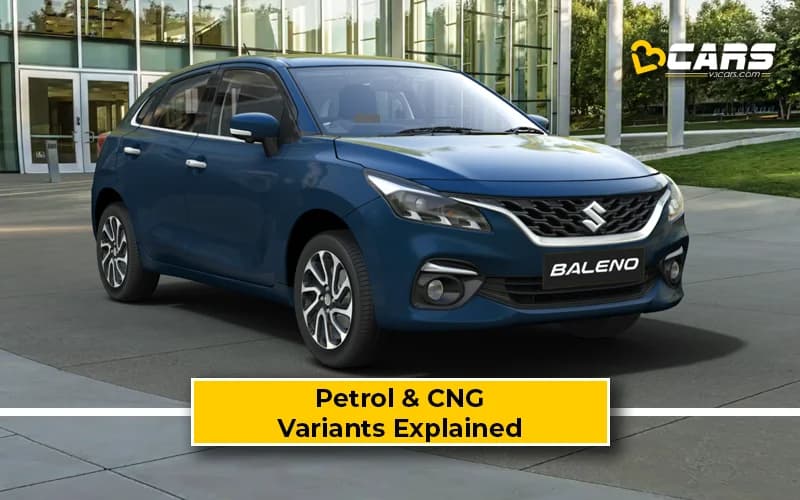
Update (July 20, 2025): Maruti have launched the 2025 Baleno with 6 airbags as standard. Maruti have also revised the prices of the Baleno in July 2025. This update of the Maruti Baleno variants explained article includes the latest prices and buying recommendations for each variant.
Also Read: Maruti Fronx Petrol, CNG Variants Explained — Which One To Buy?
2025 Tata Altroz Facelift Petrol, Diesel, CNG Variants Explained — Which One To Buy?
What Are The Pros And Cons Of Maruti Baleno Petrol And CNG?
The pros or advantages of Maruti Baleno are:
- Standard features such as 6 airbags, auto AC, tilt steering, all power windows, central locking, projector headlamps, 5x 3-point seatbelts and rear defogger make it a compelling package for budget buyers
- Best-in-class fuel efficiency of almost 23kmpl
- Affordable and efficient AMT automatic costs just Rs. 55,000 Rs. 50,000 more than manual and is available in 3 of the 4 variants
- Wide sales and service network, easy availability of spares and skilled labour of the Baleno will make it easy to own and maintain
- Good resale value because of high popularity and demand in new as well as used market
- For what (ever) it’s worth, a respectable 4-star BNCAP crash test rating
- One of the rare cars in the B2 segment with a CNG bi-fuel option — No longer applicable after Altroz CNG
The Maruti Suzuki Baleno has the following shortcomings or problems:
- No diesel engine option (available in the Altroz) and no turbo petrol engine option (available in Altroz, i20)
- Missing features like rear armrest, tyre pressure monitoring and sunroof
- While the AMT automatic keeps the cost in check, some premium hatchback buyers prefer a smoother and refined CVT, DCT or TC automatic; Altroz offer DCT while i20 offers CVT option
- Boot space with the CNG kit is almost non-existent; the Altroz offers a usable 211-litre cargo volume even with the factory-CNG kit
- Most of the new and unique features are reserved for the Alpha variant, which carries a slightly higher incremental price, making it a little difficult to justify the upgrade
- Poor feature distribution not only leaves some features out of the equation but also reserves some useful ones for higher variants, where you have to pay for some useless features (for instance, you have to pay for large, 16-inch alloy wheels to get 4 extra airbags and front armrest and you still don’t get cruise control; you have to pay for machined alloy wheels, head-up display and 360 camera to get tinted windows and cruise control and you still don’t get rear armrest and TPMS)
What Is The Price Of Maruti Suzuki Baleno Petrol, CNG Variants?
The Maruti Baleno is available with a CNG-manual, petrol-manual and petrol-automatic powertrains. The petrol-manual combination is available in all 4 variants with prices ranging from Rs. 6.74 lakh for the base model and going up to Rs. 9.46 lakh for the top model. The petrol-automatic powertrain is available in the higher 3 variants for an additional price of Rs. 50,000. The Delta variant is the most affordable option with the petrol-automatic and it costs Rs. 8.08 lakh. The most expensive, Alpha variant of the Baleno with the petrol-automatic costs Rs. 9.96 lakh.
The CNG-manual powertrain is available in the mid-spec Delta and Zeta variants with an ex-showroom price of Rs. 8.48 lakh and Rs. 9.41 lakh, respectively. These prices are Rs. 90,000 higher than those of the respective petrol-manual variants.
Note: Check your Car EMI with our - Car EMI Calculator
Maruti Baleno Sigma — Base Model Features
The base Sigma variant of the Maruti Baleno hatchback only comes with the 1.2L normal petrol engine and a manual transmission and costs Rs. 6.74 lakh (ex-showroom). The most notable features of the Baleno’s Sigma base model are:
In the base variant, you might miss features like:
- TPMS
- Rear parcel tray
- Steering mounted controls
- Height-adjustable driver seat
- Rear parking camera
- Power mirrors
- Music system
- Wheel covers
The base model of the Baleno gets a few must-have features but also misses out on some. Since the price jump to the next variant is too much for the additional features, we will suggest you buy the base variant and add some aftermarket accessories. Given the poor value score of the next variant, we reckon this is a better option.
Maruti Baleno Sigma vs Delta Variant — Price, Feature Comparison
The Baleno Delta petrol-manual costs Rs. 7.58 lakh, which is Rs. 84,000 more than the Sigma. Delta and higher variants also get the option of a 5-speed AMT automatic for an additional Rs. 50,000. The Delta AMT costs Rs. 8.08 lakh. The Delta variant also gets the option of CNG-manual powertrain for an additional Rs. 90,000 and it costs Rs. 8.48 lakh (ex-showroom).
The Delta variant gets the following extra features over the Baleno base model:
In this variant, you might miss features like:
- Front armrest
- TPMS
- Height-adjustable driver seat
- 60-40 split-folding rear seatbacks
The Delta variant adds a bunch of must-have features, but this upgrade is not recommended as it only justifies about 60% of the cost over the base variant. With the automatic, it’s slightly better at 75%. If you’re interested in the Baleno Delta, we would recommend you either stretch your budget for the Zeta, which is our top recommendation. Alternatively, you can also contain your expense by buying the Sigma base variant and adding some aftermarket accessories. This is also a good option from a value and financial angle.
Maruti Baleno Petrol Delta vs Zeta Variant — Price, Feature Comparison
The Baleno Zeta costs Rs. 8.51 lakh with the manual and Rs. 9.01 lakh with the automatic. With the CNG bi-fuel option, this variant costs Rs. 9.41 lakh. This is a price jump of Rs. 93,000 over the lower Delta variant.
The Baleno Zeta gets the following additional features over Delta:
In this variant, you may miss features like:
- TPMS
- Rear armrest
- Cruise control
- Fog lamps
- Machined alloy wheels
- Tinted windows
The Zeta variant of the Baleno adds most of the must-have features but it also includes some good-to-have features. Because of the addition of some features with high perceived cost but low functionality, such as alloy wheels, the value quotient is quite well justified. Its VFM score is 96% with petrol-manual, 97% with petrol-automatic and 78% with CNG-manual. This is naturally our top recommendation for most Baleno buyers even though it misses out on some features. Buyers interested in CNG should know that even the Zeta variant is only justifying 78% value for money. This is because of the significant drop in power, torque and boot space compared to petrol model. So, consider buying it only if you intend to drive the car for more than 1 lakh kilometre and you don’t mind the drop in performance and cargo volume.
Maruti Baleno Petrol Zeta vs Alpha Variant — Price, Feature Comparison
The Baleno’s Alpha top model costs Rs. 9.46 lakh with the manual and Rs. 9.96 lakh with the automatic. This variant is Rs. 95,000 more expensive than the lower Zeta variant.
The Baleno top model Alpha gets the following additional features over the Baleno Zeta:
In this variant, you may miss features like:
- Rear armrest
- TPMS
- Sunroof (available in i20 and Altroz)
The top variant of the Baleno gets a few high-cost but low functionality features such as LED DRLs, machined alloy wheels, larger touchscreen and a head-up display. Since we have to factor in the value of these features, it ends up justifying about 90% of the incremental cost over the base variant. So from a value angle, this variant is worth considering if you value these features and don’t mind stretching the budget. However, it doesn’t add enough compelling features to earn the top recommendation.
Which Variant Of The Maruti Baleno Petrol, CNG Should You Buy?
Let’s start with the buying recommendation for the petrol-manual variants of the Baleno.
Among the 4 variants, the base model lacks a few must-have features while the higher Delta variant offers some of them. But, the upgrade to the Delta trim is a fair bit overpriced for what it adds to the feature list. So, we’ll suggest you either jump straight to Zeta or buy the Sigma base trim and add some aftermarket accessories.
Moving on, the Zeta variant manages to almost justify the incremental cost from the base trim because of features with high perceived cost such as alloy wheels. While some of its features may not be relevant for you, the sheer value quotient and the balanced feature mix makes it compelling enough to make the Zeta our top recommendation. From here, the Alpha is not a bad option either from a value standpoint. But it doesn’t add enough must-have features to warrant an upgrade. If you have the budget and value some of its features, then you should totally buy the top variant.
Among the 3 AMT automatic variants, the Delta pales in comparison with the Zeta, which offers 97% value for money with the features over the Sigma variant. Naturally, the Zeta trim is our top recommendation while Alpha is worth considering if you don’t mind some of the less useful features like head-up display and larger touchscreen.
Just like the petrol variants, among the 2 CNG options, the Zeta is the only one worth buying. The Delta variant barely manages to break past the 50% VFM score. This is after we factored in the considerable drop in performance, boot space and lower fuel cost with Delhi fuel prices for a 50,000km of driving during the ownership. It also came as a positive surprise that the Baleno Zeta CNG managed to achieve a decent score of 78%. Since we have started including performance and boot space differences a few months ago, only the Altroz CNG car has managed to achieve a 90% or higher score. Zeta variant is the only one worth considering for Baleno CNG buyers.
What Are The Engine Specifications Of The Maruti Baleno Petrol, CNG?
The Baleno gets the 1.2L normal petrol engine with the 5-speed manual and 5-speed automatic transmission options. In this segment, Baleno offers the best power output figures.
Naturally, it’s the most fuel efficient car in its class, handily beating its rivals with at least 10% or better mileage figures. Its torque output remains on par with most other premium hatchbacks, which are available with a normal petrol engine.
*Estimated
As a B2-segment CNG hatchback buyer, you will have 3 options – Altroz, Baleno and Glanza. Since the Baleno and Glanza share the powertrains, there isn’t any difference in performance either. The Baleno CNG makes almost 77PS of power and almost 99Nm of torque with the 1.2L normal CNG engine. The mileage figure, though, is astonishing at 30.61kmpkg.
The Altroz has similar power output but a slightly better torque coming in at a lower RPM. However,we don’t expect the Altroz to challenge the Japanese CNG hatchbacks in terms of mileage figures.
*Estimated
Is Baleno CNG Worth Buying Over Baleno Petrol?
After factoring in the drop in performance, unusable boot space of CNG variants and lower fuel costs for driving 50,000km during the ownership, the Baleno CNG only manages to deliver about Rs. 42,000 worth of value for an asking price of Rs. 95,000. That’s only about 44% of value for the asking price. Do note that most of the drawback for this comes because of the significantly lower torque output, drivability and pretty much non-existent boot space. Even if you don’t consider any of these factors important, the drop in performance and cargo volume is significant enough to take into consideration.
You should also note that we have considered Delhi fuel prices and official mileage figures for this estimation. The value quotient may slightly vary based on the fuel price differences in your city and state. You can check the petrol and CNG prices in your area using our V3Cars Fuel Cost Calculator.
What Are The Dimensions Of The Maruti Baleno?
The Baleno is about the same size as the older Baleno. The only notable difference is in the boot space, which is slightly smaller than the older Baleno’s. In terms of dimensions, the i20 is easily the largest car in this class with the widest body and the longest wheelbase. The Altroz is another noteworthy car in this segment. The top feature worth talking about the Altroz is its factory-CNG kit. Even with the CNG cylinders, it offers a usable 210 litres of boot space.
*Estimated
What Are The Colour Options Of The Maruti Baleno?
The Baleno is available in the following 7 exterior colour options:
- Blue
- Red
- Beige (similar to copper brown)
- White
- Grey
- Silver
- Bluish black
To find out the variant-wise colour option availability of the Baleno, you can visit the following link:
Maruti Baleno – All Exterior Colour Options (Variant-wise)
Note: Here is a quick look at our length-based segmentation of cars to give you an idea of how we are classifying cars based on their size.
You can read more about vehicle segmentation at the following link: